
Review · POMPEII FROM SORRENTO
Guided Tour of Pompeii and Herculaneum with Lunch and Ticket
Two Roman cities, one Vesuvius-sized lesson. I love the way this day tour connects Pompeii and Herculaneum with guided stops and included admission, so you don’t just look at ruins—you see city life in motion. The walking is real, but the payoff is that the story stays coherent across two sites.
I also like the payoff beyond the archaeology: the winery lunch on the slopes of Vesuvius comes with a simple but enjoyable set of tastes. I do suggest planning for Pompeii lines and a long day, because crowding and time pressure can still happen at the most famous site, even with reserved entry.
In This Review
- Key takeaways before you go
- Two ruins, one coordinated day from Sorrento
- Pompeii’s big moments: from the streets to the Forum
- Archaeological Park of Pompeii: get your bearings fast
- Foro de Pompeya: the daily-life center
- Tempio di Giove Capitolino: power with Vesuvius behind it
- Macellum: the market that fed the city
- Via dell’Abbondanza: the main street link
- Stabian Baths, Lupanar, and Teatro Grande: the human side of Pompeii
- Terme Stabiane (Stabian Baths): a whole routine in stone
- Lupanar: brothel details that explain society
- Teatro Grande: shows without the ash in the way
- Winery lunch on Vesuvius: food, wine, and a break that matters
- Where the wine fits in the day
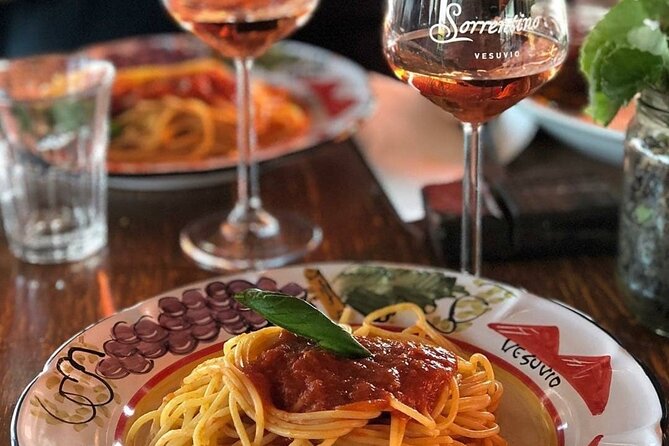
- What you’ll eat and taste
- Herculaneum’s preserved feel: streets and houses that read like home
- Parco Acheologico di Ercolano: preserved and still coherent
- Herculaneum stops that make the details click
- House of the Deer: sea-view style and a strange garden story
- Casa di Nettuno e Anfitrite: glass-paste mosaics you can’t stop staring at
- Casa dello Scheletro: the skeleton house name comes from a discovery
- Sacello degli Augustali: frescoes with myth and power
- House of the Hotel: the big house and the spa district idea
- Casa del Salone Nero: the black painted hall and waxed tablets
- Guides, pacing, and the small details that make-or-break your day
- Price and value: is $192.22 a fair deal?
- Who this tour suits best (and who should think twice)
- Should you book this Pompeii and Herculaneum tour?
- FAQ
- How long is the Pompeii and Herculaneum tour from Sorrento?
- Are admission tickets included?
- What language is the tour offered in?
- Is lunch included, and what’s served?
- What’s the group size?
- Do I need good weather?
- Can I cancel for a full refund?
Key takeaways before you go
- Two ruins, one coordinated day: guided Pompeii and Herculaneum, with timed admission included
- City-life details you can actually picture: Forum, market (Macellum), main street (Via dell’Abbondanza), and the Stabian Baths
- Offbeat stops that make the place human: the Lupanar brothel and its built-in beds, plus the Teatro Grande
- Herculaneum’s “still there” feel: houses like the House of the Deer and mosaics at Casa di Nettuno e Anfitrite
- Winery lunch with structured wine tasting: Prosecco plus red and white, alongside a local pasta plate
- Up to 100 people: a big enough group for efficiency, small enough that your guide can still herd the crowd
Other ways to walk into Pompeii
- Sorrento: Skip-the-Line Pompeii Express Tour by Train★ 4.8 · 2,038 reviews
- Priority Access Pompeii & Mt. Vesuvius Full day from Sorrento★ 4.5 · 1,376 reviews
- Pompeii Express Guided Tour by Train from Sorrento★ 4.5 · 770 reviews
- Sorrento: Pompeii Half-Day Guided Tour with Priority Access★ 4.7 · 739 reviews
Two ruins, one coordinated day from Sorrento
This is a classic Campania one-day hit: you start in Sorrento, then spend the day bouncing between Pompeii and Herculaneum. It’s about 9 hours total, and tickets for the main sites are included, with the day handled in English for the group.
The key value here is not only that both archaeological parks are included. It’s that the stops are chosen so you move from public life to private life, and then from Pompeii’s scale to Herculaneum’s preservation. Pompeii can feel like a whole city you can get lost in; Herculaneum can feel like someone paused everyday life mid-sentence.
Also, you’ll want to take the practical stuff seriously. This is not a sit-and-watch tour. You’re on foot through historic streets and into excavated buildings. Comfortable shoes matter, and sunscreen matters—summer sun on volcanic terrain doesn’t play nice.
Pompeii’s big moments: from the streets to the Forum
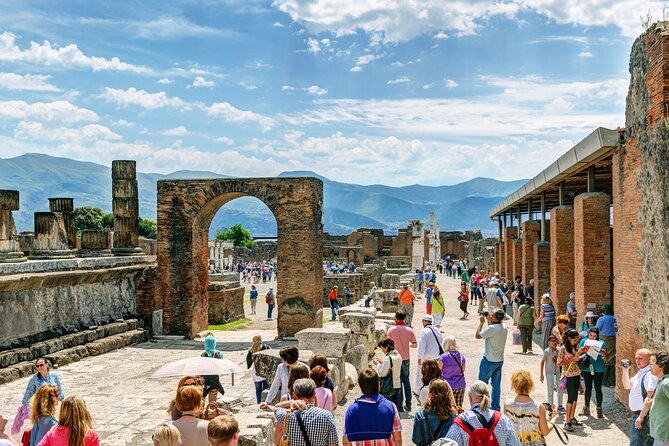
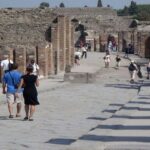
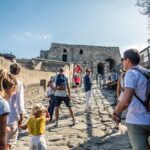
Pompeii starts with the broad view: the Archaeological Park gives you the main framework—streets, house fronts, and spaces that help you orient fast. Even if you’ve seen photos before, this first segment is where the city size clicks.
Then the tour tightens into civic life.
Archaeological Park of Pompeii: get your bearings fast
You’ll be able to freely explore parts of the excavated area during this section, which is a good thing. Pompeii is huge, and having a guide set context while you walk lets you spot details you’d miss if you stayed only in a “look at this, move on” loop.
What to watch for: try to keep track of the main routes your guide references (especially the connection between the Forum area and the amphitheater route). It makes the rest of the stops feel like a connected map instead of separate photo opportunities.
Foro de Pompeya: the daily-life center
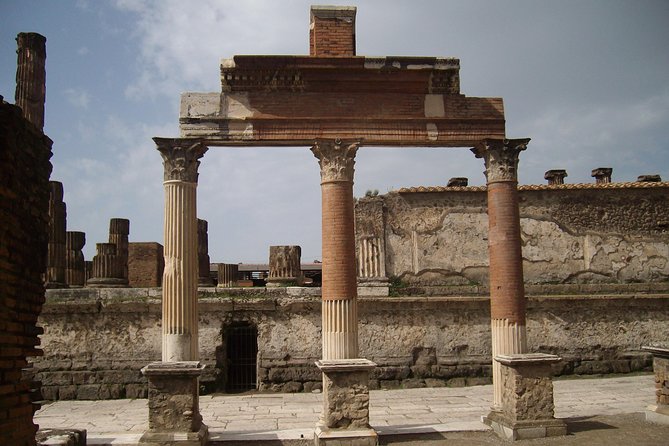
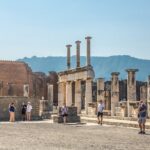
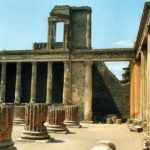
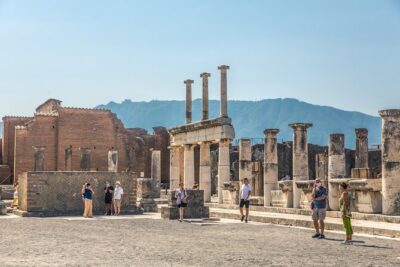
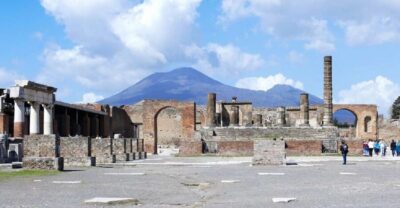
The Forum (Foro de Pompeya) is the administrative and public heart. This is where you see how government, law, business, and worship overlapped in one central space.
I like this stop because it turns Pompeii from “cool ruins” into “how people organized their day.” When you stand in the Forum, it’s easier to imagine errands, announcements, deals, and religious moments all happening within walking distance.
The quieter dig: more Herculaneum visits
Tempio di Giove Capitolino: power with Vesuvius behind it
On the north side of the Forum, the Temple of Jupiter (Tempio di Giove Capitolino) is framed by a dramatic backdrop—Vesuvius rises behind it. The temple became a real Capitolium after the colony was established, and the guide’s explanation of the cult statues of Jupiter, Juno, and Minerva (modeled on Rome’s) helps you understand what the Romans were signaling: loyalty, identity, and authority.
If you’re the type who likes symbolism, this is a strong stop. If you’re more into architecture details, pay attention to how the guide connects the temple design to visibility from the Forum square.
Macellum: the market that fed the city
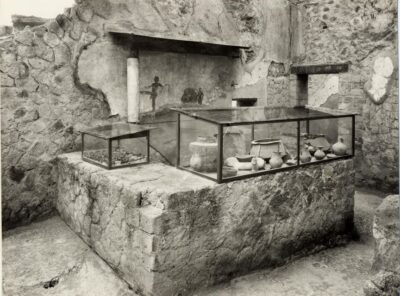
Next comes the Macellum, Pompeii’s market complex. It’s not just a “place to buy food.” The structure includes porticoes and a market hall, and the wall decorations reflect daily activities—selling fish and poultry—plus myth themes.
This stop is great for visualizing a city’s routine. When you can link the Forum (public life) to the market (food supply), you get a more complete picture of how people actually lived.
Via dell’Abbondanza: the main street link
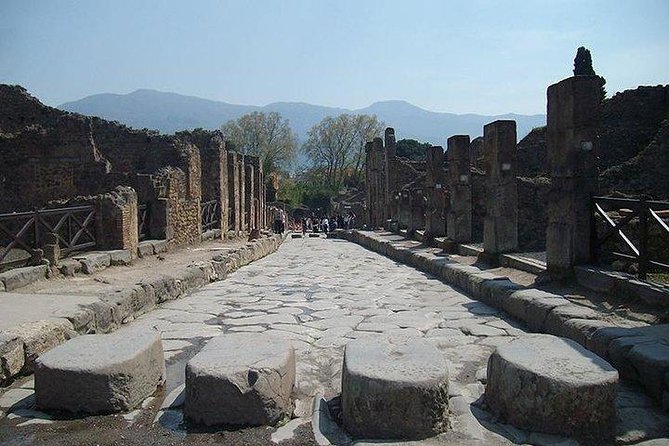
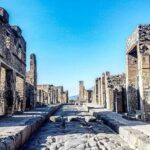
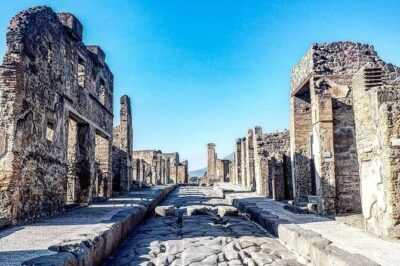
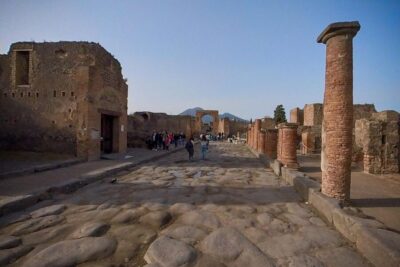
Via dell’Abbondanza connects the Forum with the amphitheater. It’s one of those streets that makes Pompeii feel like a real city grid, not a museum.
If you’re short on time, streets like this are worth your attention. They show movement—where crowds gathered, where people walked for shows, and how public space funneled into daily life.
Stabian Baths, Lupanar, and Teatro Grande: the human side of Pompeii
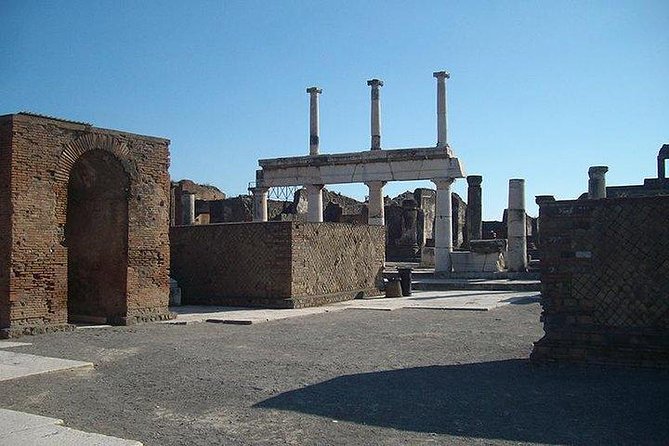
Pompeii also gets more personal. You move from public squares and markets into places for leisure, relaxation, and entertainment.
Terme Stabiane (Stabian Baths): a whole routine in stone
The Stabian Baths are a standout because the tour doesn’t just point at ruins—it explains the sequence. You’ll learn how bathing broke into zones: apodyterium (changing area), frigidarium (cold water), tepidarium (warm), then calidarium (hot).
Even better, you get the practical building logic: heating came from wall piping, and hot air circulated through double floors fed by furnaces and braziers. The guide may also touch on what these spaces were for beyond washing—talks, politics, trials, and social life.
Possible drawback: because this stop is so detailed, it can be emotionally intense if you’re tired. It’s a lot of information packed into a walking day. Bring water and let your feet recover between stops when the tour gives a short breather.
Lupanar: brothel details that explain society
The Lupanar (Pompeii’s brothel) is one of the most well-known buildings, and for a reason: erotic paintings, a two-floor layout, and built-in beds. The tour context matters here. It links the brothel to how sex work operated in Roman-era society, including details about Greek and Oriental slaves who were often enslaved workers.
I found this stop useful for understanding that Pompeii wasn’t sanitized. It was a real city with real institutions, including those Romans avoided discussing in polite company.
Teatro Grande: shows without the ash in the way
The Large Theatre (Teatro Grande) was built around the middle of the 2nd century BC and restored in Roman style. The stop also connects to an important fact: it was the first large public building freed from eruption deposits.
This gives the theatre a different feel than smaller room discoveries. You can sense it as a crowd venue. It’s also a reminder that Pompeii’s residents had performances and social events—life included art and spectacle.
Winery lunch on Vesuvius: food, wine, and a break that matters
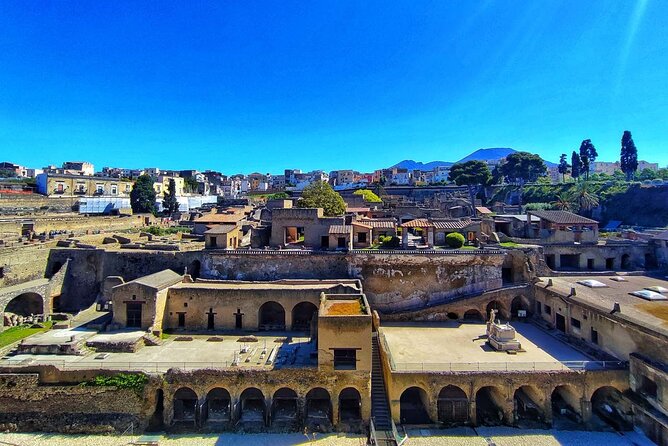
A day that heavy needs a reset, and this tour gives you one in the form of a winery stop: Sorrentino Vini.
Where the wine fits in the day
Sorrento to Pompeii to Herculaneum is a lot of moving, and the schedule is clearly designed to keep energy up. In addition to lunch, there’s time built in so the day doesn’t become a nonstop sprint through buildings.
What you’ll eat and taste
Lunch at the winery is designed as a “you’ll be fueled” meal:
- Starter: bruschetta, cured meats, cheeses, and seasonal vegetables
- Main: pasta with Piennolo cherry tomatoes
- Dessert: traditional homemade dessert
- Plus wine tasting: Prosecco, red, and white
You might also like the vineyard story if you enjoy wine culture. Sorrentino Vini was founded in 1990 and focuses on Vesuvius wines, including Lacryma Christi, which is a DOC product. The company’s vineyards are within the Vesuvius National Park.
Practical tip: wine tasting is part of lunch, so plan to stay hydrated and don’t treat it like a full-on tasting room sprint.
Herculaneum’s preserved feel: streets and houses that read like home
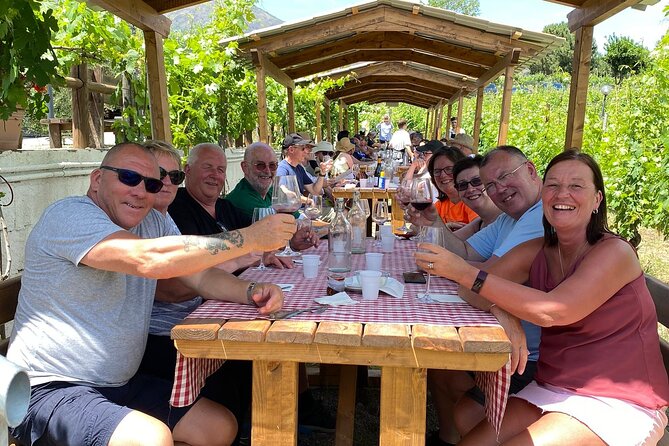
Then you shift to Herculaneum. If Pompeii is a wide “city picture,” Herculaneum is a tighter “personal life” picture.
Parco Acheologico di Ercolano: preserved and still coherent
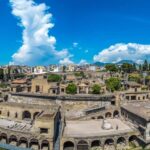
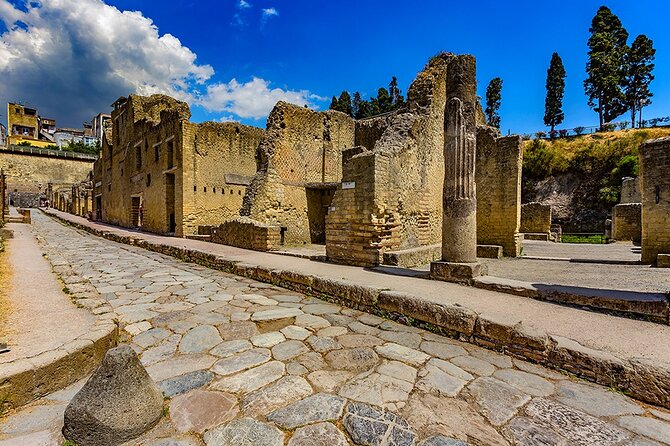
In Herculaneum, the ruins remain very well preserved. You’ll walk through excavated streets, houses, and villas where the spaces feel more “intact” than you’d expect.
I like this switch because it changes your mental model. In Pompeii, it can feel like you’re assembling a city. In Herculaneum, you often feel like you’re reading daily life as it existed.
Herculaneum stops that make the details click
House of the Deer: sea-view style and a strange garden story
The House of the Deer (with a sea view terrace) belonged to Q. Granius Verus, a slave freed shortly before the destruction of Herculaneum. The house gets its name from garden statues of deer attacked by dogs.
This stop can be surprisingly emotional if you’re into human-scale stories—someone’s status, someone’s freedom, someone’s home.
Casa di Nettuno e Anfitrite: glass-paste mosaics you can’t stop staring at
The Casa di Nettuno e Anfitrite is famous for mosaics made with glass paste—expensive materials for the time. You’ll see floral and hunting scenes, plus a central image of Neptune and Amphitrite.
If you only take one “wow detail” in Herculaneum, let it be this. The mosaics help explain why Herculaneum can feel more like a lived-in space than a pile of stones.
Casa dello Scheletro: the skeleton house name comes from a discovery
The Casa dello Scheletro is called that because human remains were found in a second-floor room in 1831, during excavation. The house may have formed from the combination of three earlier buildings.
This is one of those stops where the guide’s tone matters. The site is dramatic, but it’s also museum-like in how it becomes a research story.
Sacello degli Augustali: frescoes with myth and power
The Sacellum of the Augustales preserves splendid frescoes with Hercules entering Olympus alongside Jupiter, Juno, Minerva, and Hercules against Achelous.
A detail you’ll remember if you like symbolism: it also relates to a janitor story, since a skeleton was found in his room lying on the bed. That kind of artifact makes the human cost feel immediate.
House of the Hotel: the big house and the spa district idea
Next is the House of the Hotel—a large Roman-era home on a hill edge in a panoramic position. It’s about 2,250 square meters, and it includes a spa district, which is why it was once considered like a hotel.
Two things make it worthwhile:
1) the scale, which helps you picture wealth
2) the spa district, which mirrors how Romans treated bathing as both routine and status
Casa del Salone Nero: the black painted hall and waxed tablets
The final Herculaneum stop here is Casa del Salone Nero, known for a party hall painted black with geometric patterns. It also includes waxed tablets of L. Venidius Ennychus, which connect to eligibility for Augustale, the purchase of a slave, and the birth of a daughter.
This stop gives you something rare in archaeology: text that points to real decisions and real relationships.
Guides, pacing, and the small details that make-or-break your day
This tour can work really well when the guide manages pacing and recognition in the crowd.
In Pompeii, it can be hard to stay oriented because the site gets crowded. One thing I’d treat as a must: once you arrive, confirm where your guide will meet you and use whatever method they provide to stay together. If you prefer clear group leadership, consider arriving early and getting your bearings at the start.
Pacing is another big factor. The day is designed to cover a lot, and you should expect some sections to feel faster than you’d like—especially once Pompeii crowds swell. That said, when the guide uses clear explanations and stops that connect like a story, it feels less rushed.
Also note that the tour uses an air-conditioned van/mini bus in the middle of the day, which helps a lot when it’s hot. Still, you’ll spend time outdoors at both parks, so sunglasses, sunscreen, and comfortable shoes are not optional.
Price and value: is $192.22 a fair deal?
At $192.22 per person, this isn’t a budget “grab a seat and hope” tour. It’s priced like a structured day with:
- admission tickets included for the Pompeii and Herculaneum stops listed
- a guided visit pattern designed to hit the major areas
- a winery lunch with wine tasting
- operation in English
- a group size cap of up to 100 travelers
Here’s the value math that matters for you: the big cost in days like this is usually not just transportation—it’s admission time and guide time. If you tried to DIY this same day, you’d likely spend time figuring out tickets, getting between sites, and building a route that doesn’t waste daylight. This tour handles that planning for you and keeps the day moving with a coherent stop list.
The one warning sign is crowd reality. Even with reserved entry, Pompeii can still slow down. If you’re the kind of traveler who gets cranky when plans slip, go in with patience—and wear shoes you can walk in for hours.
Who this tour suits best (and who should think twice)
You’ll enjoy this tour if:
- you want a guided framework for two top sites in one day
- you like city-life details—markets, baths, entertainment—not just “pretty ruins”
- you want lunch plus wine tasting without extra planning
- you’re okay with a full day of walking and heat exposure
You might want to think twice if:
- you prefer deep, unhurried exploration and don’t like time pressure
- you’re sensitive to crowds at Pompeii
- you want lots of commentary during the bus ride, not only at the ruins (the site guides do the heavy lifting)
If you’re going with friends or family, it’s still a good fit because the group format keeps everyone moving. Just remind yourselves you’ll see more with structure, and less if you roam off the plan.
Should you book this Pompeii and Herculaneum tour?
I’d book it if your goal is a well-guided, ticketed day that covers Pompeii and Herculaneum in one shot, with a practical lunch stop that keeps fatigue manageable. The included wine tasting and the stop choices—from Forum and baths in Pompeii to mosaics and house interiors in Herculaneum—make the price feel more like a service fee for organization than a “pay more for tickets” deal.
Skip it only if you know you hate crowds, hate long days, or can’t stand walking on uneven historic ground. If that’s you, you may prefer a slower, single-site plan.
FAQ
How long is the Pompeii and Herculaneum tour from Sorrento?
The duration is about 9 hours.
Are admission tickets included?
Yes. Admission tickets are included for the listed Pompeii and Herculaneum stops, with at least a couple of house visits noted as free.
What language is the tour offered in?
The tour is offered in English.
Is lunch included, and what’s served?
Lunch is included at the winery. The menu includes bruschetta, cured meats, cheeses, seasonal vegetables, pasta with Piennolo cherry tomatoes, and a traditional homemade dessert, plus a tasting of Prosecco, red, and white.
What’s the group size?
The tour has a maximum of 100 travelers.
Do I need good weather?
The experience requires good weather. If it’s canceled due to poor weather, you’ll be offered a different date or a full refund.
Can I cancel for a full refund?
Yes. Free cancellation is available up to 24 hours in advance for a full refund. Canceling less than 24 hours before the start time does not receive a refund.
More Tour Reviews in Sorrento
- Sorrento Farm and Food Experience including Olive Oil, Limoncello, Wine tasting
★ 5.0 · 2,524 reviews





More of Herculaneum

Back to Pompeii
Just off the boat: newer Sorrento reviews


Pompeii from Sorrento, compared.
 ★ 4.8Skip-the-Line Pompeii Express Tour by TrainFrom $632,038 reviews
 ★ 4.5Priority Access Pompeii & Mt. Vesuvius Full day from SorrentoFrom $1391,376 reviews
 ★ 4.5Pompeii Express Guided Tour by Train from SorrentoFrom $65770 reviews
 ★ 4.7Pompeii Half-Day Guided Tour with Priority AccessFrom $84739 reviews
 ★ 4.5Skip-the-Line Pompeii Guided Tour from SorrentoFrom $90722 reviews
 ★ 4.0Pompeii Ruins Half-Day Tour from Sorrento with GuideFrom $97714 reviews
 ★ 4.8Pompeii and Vesuvius Guided Tour with LunchFrom $130683 reviews
 ★ 4.3Day Tour to Pompeii Ruins and Mount VesuviusFrom $130489 reviews
Browse the lists this tour appears in