
Review · POMPEII FROM SORRENTO
Skip the line Private tour of Pompeii from Sorrento
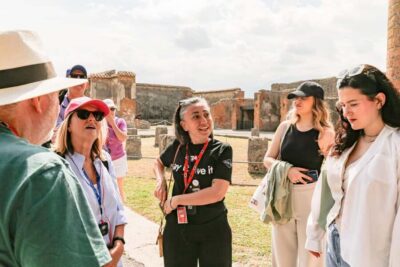
Pompeii can feel like chaos. This private tour keeps it organized and makes the sights click. I like that you’re on a tight 3 to 4 hour plan with a guide who directs your attention to the best ruins, from mosaics and theaters to the Forum area, without you wandering in circles. One thing to keep in mind: the Pompeii Archaeological Park ticket is not included, so you’ll still need to budget for entry.
What also makes this work well is the mix of logistics and people-power. Pick-up happens in Sorrento and you get train round trip tickets, while the guide has priority for ticket purchasing and you receive a mobile ticket. Names that stood out in guides include Michele, Romolo, Paolo, Josie, and Guisy—each praised for clear English, fast pacing, and attention to details like uneven ground and low doorways.
In This Review
- Key highlights to know before you go
- Private Pompeii: why the ruins make more sense in a small group
- Sorrento logistics: pickup, train ride, and not wasting your morning
- Pompeii Archaeological Park: two hours of the essentials that you’ll remember
- Temple of Apollo: a short stop with big meaning
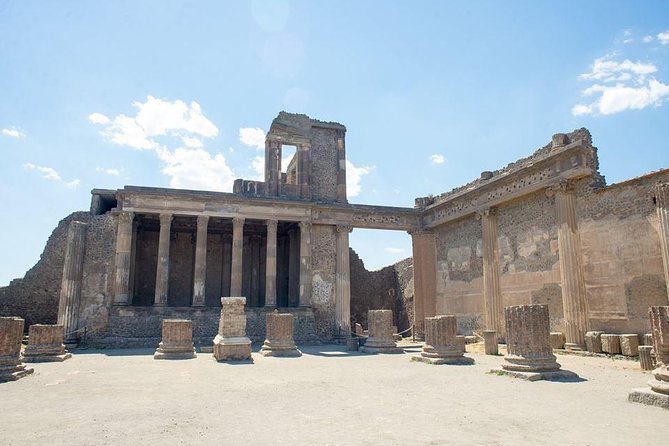
- The Forum area: the city’s center in several connected stops
- Mosaic stops that make the tour feel personal
- Via dell’Abbondanza: the main street with star power
- Theater Grande: where stories were performed
- Lupanar: a different side of city life, explained at human speed
- Guides make or break Pompeii: Michele, Romolo, Paolo, Josie, and Guisy
- Price and value: what you’re paying for, and what you still need to add
- Who this tour fits best (and who should think twice)
- My practical advice before you go
- Should you book Skip the line Private tour of Pompeii from Sorrento?
- FAQ
- Is this a private Pompeii tour?
- How long is the Pompeii tour from Sorrento?
- Do I need to buy the Pompeii Archaeological Park ticket?
- What’s included in the tour price?
- Does the tour include transport from Sorrento?
- Is the tour offered in English?
- Is free cancellation available?
Key highlights to know before you go
- Private group with a dedicated guide for questions and a calmer visit
- Skip-the-line style entry support, plus the guide has priority for tickets
- Round-trip train from Sorrento included so you don’t have to play transport roulette
- A focused mix of highlights: Temple of Apollo, Forum spaces, mosaics, theaters, and the Lupanar
- Practical guidance on walking conditions, including uneven terrain and low ceilings
Other ways to walk into Pompeii
- Sorrento: Skip-the-Line Pompeii Express Tour by Train★ 4.8 · 2,038 reviews
- Priority Access Pompeii & Mt. Vesuvius Full day from Sorrento★ 4.5 · 1,376 reviews
- Pompeii Express Guided Tour by Train from Sorrento★ 4.5 · 770 reviews
- Sorrento: Pompeii Half-Day Guided Tour with Priority Access★ 4.7 · 739 reviews
Private Pompeii: why the ruins make more sense in a small group
Pompeii is big, and it’s also very visual. Without context, you’ll see walls, floors, and doorways—and then your brain starts doing math instead of history. The private format helps you get your bearings fast. Your guide keeps the story straight as you move from one landmark to the next, and you can ask specific questions instead of waiting for a group moment.
This tour is set up so you’re not just collecting photos. You get a curated route that includes both the grand spaces (like the main square and theater) and the daily-life details (mosaics, streets, and the sites people recognize from guidebooks). The guide also paces the visit so you can cover a lot without feeling like you’re sprinting for trains.
Sorrento logistics: pickup, train ride, and not wasting your morning
The big practical win here is that you don’t have to engineer the whole day yourself. You’re picked up in Sorrento, and the tour includes train round trip tickets. That means less time scanning schedules and more time watching the route unfold.
Timing matters because Pompeii gets crowded. The guide’s priority for purchasing tickets helps smooth the start of the day, and you’ll also have a mobile ticket. In real life, that’s the difference between arriving stressed and arriving ready to walk.
The tour runs about 3 to 4 hours total, and Pompeii itself is the main event (with roughly 2 hours dedicated to the Archaeological Park highlights). The other stops are shorter, often around 10 to 20 minutes each, which is a smart format when you’re visiting for the first time and want the “greatest hits” without burning half your day in one area.
Pompeii Archaeological Park: two hours of the essentials that you’ll remember
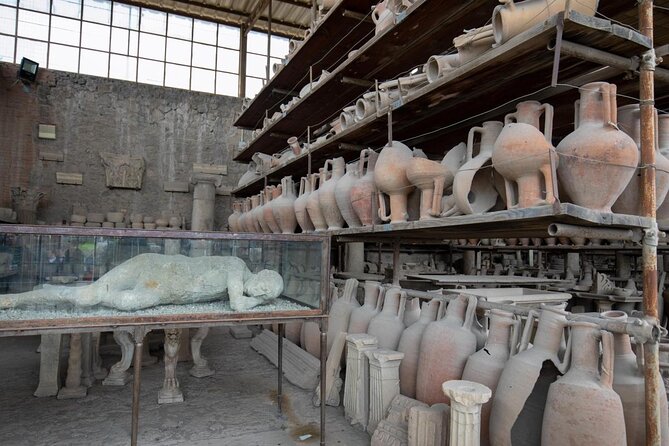
The first stop is the Pompeii Archaeological Park, where the goal is to see the best of the ancient ruins and connect the dots between neighborhoods and daily life. You’ll cover Roman villas, streets, squares, theaters, frescoes, mosaics, and even the famous human casts from the Vesuvius tragedy. You’ll also pass key areas like bakeries and the places people ate, which is crucial because Pompeii wasn’t only temples and politics—it was normal life under a city-wide catastrophe.
Here’s why this start is valuable: it gives you the big picture early. If you begin with the park sweep, later stops feel less random. You recognize the streets and understand how the Forum area fits into the city’s rhythm.
A practical note from the guides: you’ll be walking on uneven ground and dealing with low ceilings and doorways. That doesn’t mean you should skip it—it just means you’ll move better with sturdy shoes and a slightly lower center of gravity.
Temple of Apollo: a short stop with big meaning
Next up is the Temple of Apollo, a quick 10-minute visit. Short stops can feel rushed in some tours, but this works because the guide uses the moment to point out what makes the temple important—its role in the city’s spiritual life and why it’s one of the landmarks that keeps showing up in Pompeii stories.
This is the kind of stop where a guide matters. You’re not just looking at stones; you’re understanding what you’re looking at. If you’ve ever stood in a ruin site and wondered what part you’re supposed to care about, this is where that feeling gets solved.
Keep looking: more Sorrento trips along the same coast




The Forum area: the city’s center in several connected stops
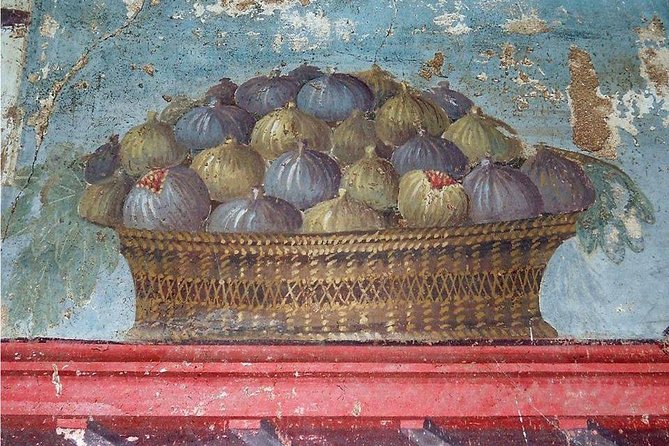
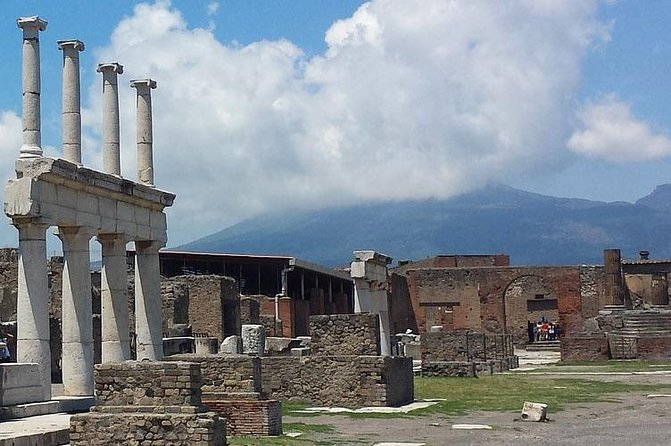
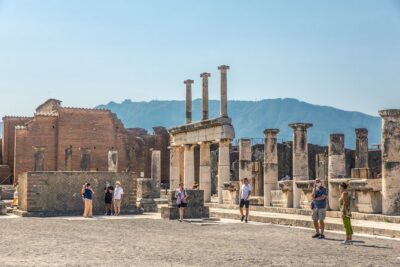
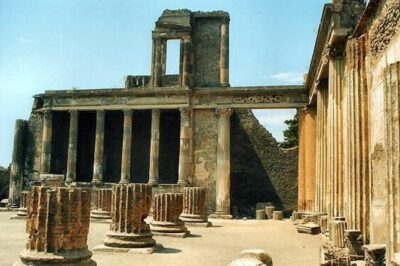
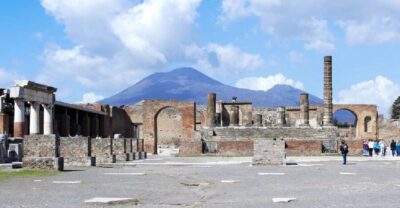
After Apollo, you move into the heart of Pompeii with the Foro de Pompeya (main square), then follow with the Granai del Foro (a museum) and the Terme del Foro (the Forum baths). Each stop is timed for impact—around 20 minutes for the Forum-related visits.
Why this sequence works: the main square explains the public space, the museum piece adds interpretation, and the baths show how daily routine played out near power and ceremony. Even if your time is limited, this combo gives you context instead of isolated photo stops.
If you like understanding how people lived, this is one of the best sections of the tour. It’s also a good place to ask questions, because the guide can connect the city’s layout to what you’re seeing in front of you.
Mosaic stops that make the tour feel personal
Pompeii is famous for mosaics, and this tour gives you a couple you’ll actually have time to look at—enough time to notice patterns and not just admire them at a glance.
You’ll visit Casa del Poeta Tragico (10 minutes) with its striking mosaic, and later Casa del Cinghiale (10 minutes), also noted for mosaics. These are brief stops, but the guide attention is what makes them click. Think of it like a guided art lesson inside an archaeological site.
The best approach at mosaic stops: don’t rush your eyes. Look for the shapes, the repeated themes, and the sense of composition. Even with short timing, you’ll come away with a mental image rather than a blur of stone.
Via dell’Abbondanza: the main street with star power
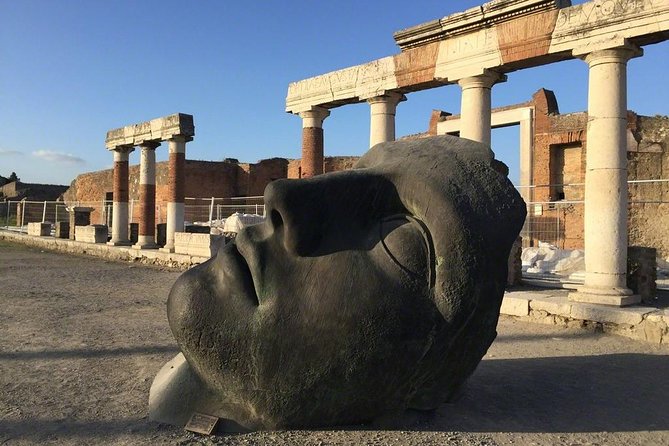
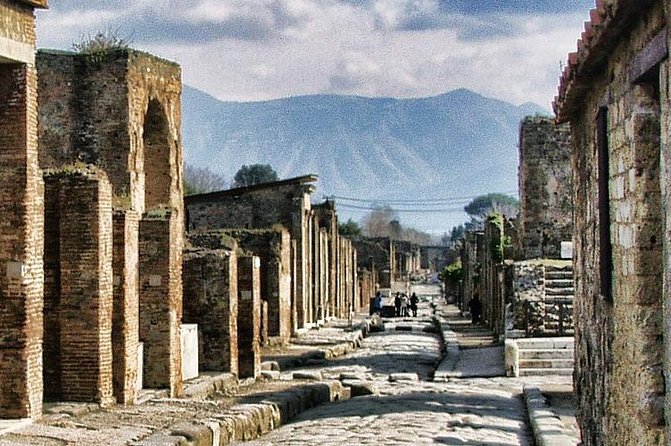
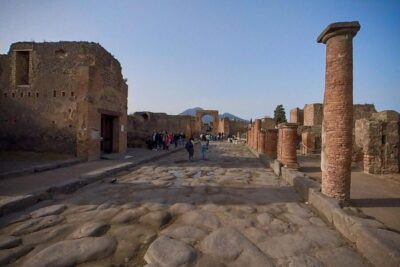
One of the most fun stops is Via dell’Abbondanza, described as the main street—basically the Beverly Hills 2000 years ago angle. It’s another 20-minute moment, and it’s a great palate cleanser between “big landmark” areas.
This street stop helps you understand movement through the city. Instead of bouncing from one isolated ruin to another, you see the idea of a commercial and social corridor—where people walked, traded, and built their day around public space.
Theater Grande: where stories were performed
Next is Teatro Grande, about 20 minutes, tied to the drama of tragedies and comedies. This is one of those places where seeing it in person changes your sense of scale. A guide can help you picture how the theater worked and why it mattered to the community.
If you like performance arts or you’re traveling with teens, this is often a hit. It gives you a different vibe than temples and rooms—it’s about spectacle and shared culture.
Lupanar: a different side of city life, explained at human speed
You’ll also visit the Lupanar (around 20 minutes). Even if you’ve heard the name before, it’s worth seeing it with context from a guide, because Pompeii’s city life wasn’t only public events and elite homes. This stop rounds out the picture with something more private and very human.
It’s also a stop where pacing matters. You’ll get enough time to absorb what you’re looking at without the feeling that you’re stuck reading every corner in silence. The guide helps you understand the role of the space in everyday life.
Guides make or break Pompeii: Michele, Romolo, Paolo, Josie, and Guisy
This is where the tour earns its excellent reputation. Different guides bring different flavors, but the common thread is direction and clarity.
- Michele is praised for passion and knowledge, along with a strong grasp of what you’re seeing.
- Romolo is noted for story-telling that creates a picture of what the city was like before the eruption, plus careful physical awareness—like alerting people to uneven ground and low areas.
- Paolo is described as personable and friendly, with good English and an easy rhythm that doesn’t leave you lost.
- Josie is singled out for easy-to-follow English and for navigating crowds in ways that reduce waiting. The same guide also offered a lunch recommendation after the tour.
- Guisy worked well with kids ages 7 and 11, keeping them attentive from start to finish.
If you’re the type who wants to understand what you’re looking at, a strong guide is the difference between a “sightseeing day” and a “I get it now” day.
Price and value: what you’re paying for, and what you still need to add
At $132.45 per person, this tour isn’t the cheapest way to reach Pompeii. It’s also not trying to be. The value is in the time saved and the human guidance.
Here’s what your price covers:
- Train round trip tickets
- Pick-up in Sorrento
- A tourist guide
- Priority for purchasing tickets (helping with the start)
- Mobile ticket
- Private tour format (only your group)
What you still pay for:
- Pompeii Archaeological Park ticket is not included
One more detail matters: the short named stops include admissions labeled as included—like Temple of Apollo, Forum spaces, baths, and the museum stop. That means your spending isn’t just one big entry and then everything else is extra; the pricing structure reduces add-on surprises.
So how should you judge value? I’d treat this as a “pay for smooth” option. You’re buying logistics and interpretation, not only access. If you’re short on time, traveling with kids, or easily overwhelmed in crowds, the private structure usually pays off quickly.
Who this tour fits best (and who should think twice)
This tour fits best if you:
- Want a first-timer Pompeii visit without getting lost
- Prefer asking questions one-on-one or in a small private setting
- Travel with kids and need a guide who can keep attention steady (Guisy’s family experience is a strong sign)
- Like a guided approach that balances major sites and smaller details like mosaics
You might think twice if you:
- Want an extremely long, slow walk through Pompeii with deep study in one single area
- Plan to arrive with zero interest in interpretation and only want to wander (Pompeii is too large for pure wandering to feel satisfying)
My practical advice before you go
Pompeii is outdoors and uneven in spots. To get the most from those short stops, wear shoes you trust. The guides emphasize attention to low doorways and uneven terrain, so plan for careful steps.
Also, since the Pompeii entry ticket is not included, check your budgeting before you commit. The guide’s priority ticket purchasing helps reduce friction, but the admission itself still falls to you.
Finally, if you love good photos, I’d still focus on what you’re being taught. A good guide will point you to the details that make the photos better later. The route is designed to help you see what matters.
Should you book Skip the line Private tour of Pompeii from Sorrento?
I’d book it if you want Pompeii to feel organized, teachable, and efficient. The combination of private pacing, train logistics from Sorrento, and a guide who pays attention to real walking challenges is a smart way to make limited time count.
I’d reconsider only if you’re trying to minimize cost above all else, because the Pompeii ticket isn’t included and private tours generally cost more than self-guided visits. But for many people, the payoff is simple: less waiting, less confusion, more understanding.
If your goal is to leave Pompeii with clear memories—temple, Forum, mosaics, theater, and the Lupanar—this tour is built for exactly that.
FAQ
Is this a private Pompeii tour?
Yes. It’s a private tour/activity, so only your group participates.
How long is the Pompeii tour from Sorrento?
The duration is about 3 to 4 hours.
Do I need to buy the Pompeii Archaeological Park ticket?
Yes. The Archaeological Park Pompeii ticket is not included.
What’s included in the tour price?
The tour includes train round trip tickets, pickup in Sorrento, and a tourist guide. The guide also has priority for purchasing tickets. Admission is marked as included for several specific stops during the visit.
Does the tour include transport from Sorrento?
Yes. Train round trip tickets are included, and pickup is provided in Sorrento.
Is the tour offered in English?
Yes. The tour is offered in English.
Is free cancellation available?
Yes. You can cancel for a full refund up to 24 hours in advance of the experience start time.
More Tours in Sorrento




More Tour Reviews in Sorrento
- Sorrento Farm and Food Experience including Olive Oil, Limoncello, Wine tasting
★ 5.0 · 2,524 reviews


Back to Pompeii


Just off the boat: newer Sorrento reviews




Pompeii from Sorrento, compared.
 ★ 4.8Skip-the-Line Pompeii Express Tour by TrainFrom $632,038 reviews
 ★ 4.5Priority Access Pompeii & Mt. Vesuvius Full day from SorrentoFrom $1391,376 reviews
 ★ 4.5Pompeii Express Guided Tour by Train from SorrentoFrom $65770 reviews
 ★ 4.7Pompeii Half-Day Guided Tour with Priority AccessFrom $84739 reviews
 ★ 4.5Skip-the-Line Pompeii Guided Tour from SorrentoFrom $90722 reviews
 ★ 4.0Pompeii Ruins Half-Day Tour from Sorrento with GuideFrom $97714 reviews
 ★ 4.8Pompeii and Vesuvius Guided Tour with LunchFrom $130683 reviews
 ★ 4.3Day Tour to Pompeii Ruins and Mount VesuviusFrom $130489 reviews
Browse the lists this tour appears in