

Review · POMPEII FROM SORRENTO
Skip the line Pompeii Guided Tour
Pompeii is big enough to swallow your whole day. This 4-hour guided tour helps you see the right stuff fast, with headsets so you actually hear the story, plus Pompeii entry included. I like the tight route of short, specific stops, and I like how the pacing tends to work well before the hottest part of the day hits—so you spend less time baking and more time looking. One caution: if anything goes sideways with the bus, your group may get rerouted, and that can mean waiting or a slightly different flow once you arrive.
You’ll start with pickup from Sorrento or Naples, then ride a 30-seater bus (group size can be up to 100 on the overall tour). Once inside Pompeii, you get an English-speaking guide for about 2 hours, and the itinerary is organized into bite-sized chunks: Forum, major temples, baths, even the brothel and a theater. It’s ideal if you want a “greatest hits” first look and want context as you walk.
The possible drawback is simple: Pompeii rewards slow wandering, but this plan is built for momentum. If you’re the type who likes to pause for 20 minutes to read every wall and sketch every mosaic, you may feel a little time pressure.
In This Review
- Key things to know before you go
- Why this Pompeii tour works better than solo wandering
- Pickup from Sorrento or Naples: the logistics that save your time
- “Skip the line” expectations: what you can realistically count on
- Stop 1: Archaeological Park of Pompeii (2 hours, ticket included)
- Stop 2: Foro de Pompeya (10 minutes, ticket included)
- Stop 3: Tempio di Giove Capitolino (15 minutes, ticket included)
- Stop 4: Macellum (15 minutes, ticket included)
- Stop 5: Via dell’Abbondanza (10 minutes, ticket included)
- Stop 6: Stabian Baths (Terme Stabiane) (15 minutes, ticket included)
- Stop 7: The brothel of Pompeii (15 minutes, ticket included)
- Stop 8: Teatro Grande (15 minutes, ticket included)
- Price and value: is about $96 worth it?
- Pace, crowds, and the one real risk to plan for
- Who this tour is best for
- Should you book this Pompeii skip-the-line guided tour?
- FAQ
- How long is the Pompeii guided tour?
- What stops are included during the visit?
- Is the Pompeii entrance ticket included?
- Do I need lunch during the tour?
- What language is the guide?
- Will I get help hearing the guide in crowded areas?
- Where does pickup happen?
- Can I cancel if plans change?
- What happens if the weather is poor?
Key things to know before you go
- Headsets included: clearer guide audio even in crowded areas.
- Included Pompeii ticket: no separate purchase at the gate.
- Short stops across Pompeii’s highlights: you get a structured route instead of getting lost.
- Baths + market + public buildings: you see more than just streets and houses.
- English guide, timed visit: good for first-timers who want context quickly.
- Bus transfer from Sorrento or Naples: fewer logistics headaches, more time for ruins.
Other ways to walk into Pompeii
- Sorrento: Skip-the-Line Pompeii Express Tour by Train★ 4.8 · 2,038 reviews
- Priority Access Pompeii & Mt. Vesuvius Full day from Sorrento★ 4.5 · 1,376 reviews
- Pompeii Express Guided Tour by Train from Sorrento★ 4.5 · 770 reviews
- Sorrento: Pompeii Half-Day Guided Tour with Priority Access★ 4.7 · 739 reviews
Why this Pompeii tour works better than solo wandering
Pompeii isn’t just ruins. It’s a whole ruined city, with streets, public spaces, and buildings that still show you how people lived. The hard part for many first-timers is figuring out what to prioritize once you’re inside. This tour solves that with a guided, stop-by-stop route that’s designed to hit major zones without turning your day into a guessing game.
I also like that the operator doesn’t leave you to interpret everything through your own reading. The itinerary focuses on public life (Forum), daily life (market area), and “Roman routine” (the baths). You’ll also see how entertainment and taboo show up in the same city—through the theater and the brothel.
One small practical plus: the guide is paired with headsets, which matters in Pompeii. Even if you’re near the front, crowds can make it hard to hear explanations. Clear audio makes a big difference when you’re trying to connect what you’re seeing with what the guide is saying.
Pickup from Sorrento or Naples: the logistics that save your time
This tour includes pickup at a meeting point in Sorrento or Naples, then you transfer by 30-seater bus. That matters because getting from the Amalfi/Sorrento area to Pompeii can involve multiple steps—trains, timing, and transfers. Here, you’re handed the simple version: meet, board, arrive.
A practical tip: get to your meeting point early. Not because you’ll be late, but because Pompeii tours can run on tight timing inside the park. One missed step can ripple into the rest of the day.
Also note the group structure: the bus is 30-seat, but the activity has a maximum of 100 travelers. That usually means you’ll move as a larger group at the start and then your experience inside the ruins may feel like a smaller cluster during the actual walking and stops.
“Skip the line” expectations: what you can realistically count on
The title says skip-the-line, and the most solid, factual part you can rely on is that your entrance ticket is included. That typically reduces friction: you don’t have to figure out ticket counters while other people are queueing.
Still, Pompeii is Pompeii. Crowds happen, and security and entry processes are real. I’d frame this as: you’ll avoid the stress of arranging your own entry, and you’ll be guided through a timed, route-based visit rather than a free-for-all.
If you’re a stickler for zero waiting, plan for small delays. One past issue reported by a small party involved a bus mechanical problem that led to a private minivan transfer instead of the original bus. The key point for you: disruptions can change the flow once you arrive, so keep your expectations flexible.
Stop 1: Archaeological Park of Pompeii (2 hours, ticket included)
This is the big moment. The Archaeological Park of Pompeii is vast, and it covers remains of a Roman city buried under ash and pumice after Mount Vesuvius erupted in 79 AD.
You’ll start here with about 2 hours allocated at the park itself, and it’s the portion where the guide can help you “read” the city. Instead of treating it like random stone piles, you’ll get a sense of how street layouts and building placements relate to daily life.
Here’s what I think you’ll enjoy most during this first stop:
- You can orient yourself quickly—Pompeii is easier when you know what kind of buildings you’re looking at.
- A guide helps you notice details you might otherwise miss, like how spaces were designed for movement, work, and gatherings.
- You get enough time to wander through real excavated streets and structures rather than just popping in for photos.
The drawback is built into the format: 2 hours goes fast in a site this size. If you want the deepest possible dive into every single street corner, you’ll likely crave more time than this plan offers.
Keep looking: more Sorrento trips along the same coast


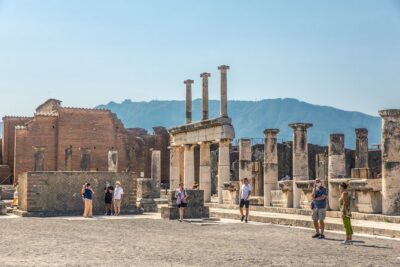
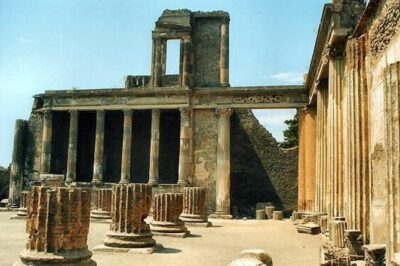
Stop 2: Foro de Pompeya (10 minutes, ticket included)
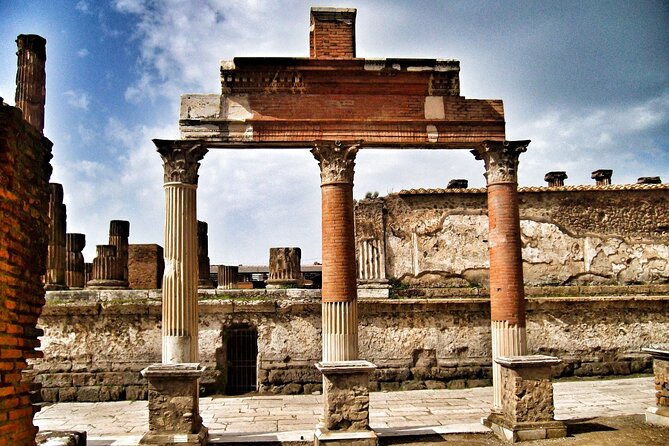
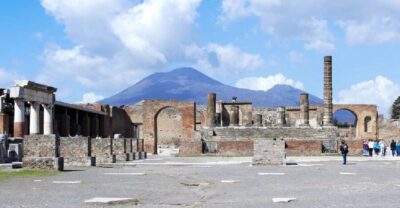
The Forum is the city’s public heart. The description here is clear: this is where administration and justice happened, where business and commerce ran, and where people gathered around worship spaces.
Even though this stop is only 10 minutes, it’s a smart use of time. The Forum gives you a mental map of Pompeii’s priorities: politics, religion, and commerce all in one place. When you later see markets and baths, you’ll understand them as part of a wider daily rhythm.
If you’re taking photos, this is a good time to do it. Forum architecture tends to be visually strong, and Vesuvius often becomes part of the scene when you look toward the temple zone.
Stop 3: Tempio di Giove Capitolino (15 minutes, ticket included)
Next up is the Temple of Jupiter, positioned on the northern side of the Forum. What makes it special on this route is the framing: Vesuvius rises behind it, so you get a dramatic visual connection between the city and the disaster that preserved it.
The temple also mattered in the city’s identity after Pompeii’s colony status (noting the renovation date in the tour description). The key idea is that it became a real Capitolium and was associated with the statues of Jupiter, Juno, and Minerva, placed so they could be seen by people passing through the Forum square.
A 15-minute stop may sound short, but temples are exactly the kind of place where context helps. You’ll likely appreciate the space more if you know what it represented, not just what it looks like.
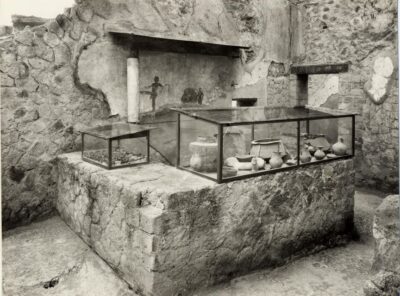
Stop 4: Macellum (15 minutes, ticket included)
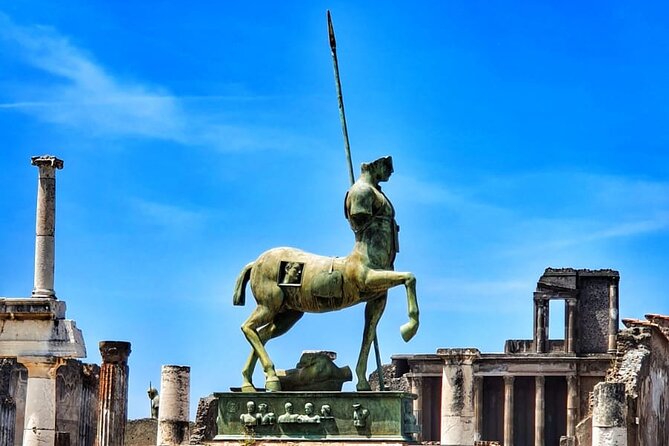
The Macellum is the market area. This is one of my favorite stops on the route because it connects architecture to everyday needs—food, buying, and the social side of commerce.
The Macellum consists of a tuff Quadri porticus with an elevated hall for worship aligned with the entrance. In plain terms: it’s a market complex, placed just north-east of the Forum so it wouldn’t choke the square with too much crowding.
You’ll also see how the porticoes were decorated, with scenes tied to daily life like selling fish and poultry, plus mythological subjects. That mix matters. It shows you that even “practical” spaces had messaging and storytelling built into them.
Drawback to keep in mind: markets are visual and interesting, but they’re also the kinds of areas where crowds can build. Your headsets and group timing help, but you still may have to share viewing space.
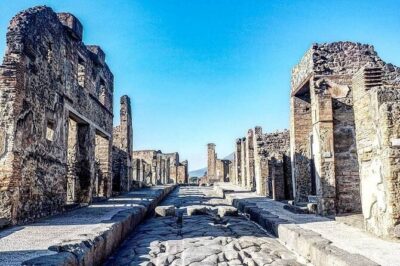
Stop 5: Via dell’Abbondanza (10 minutes, ticket included)
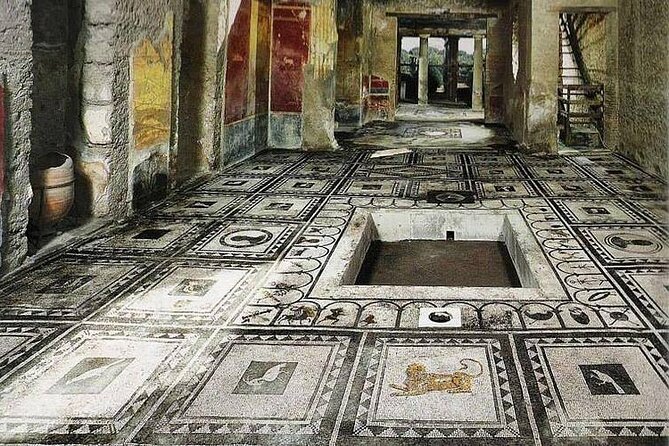
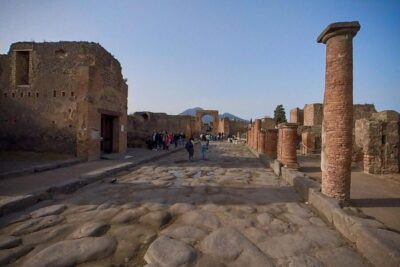
Then comes Via dell’Abbondanza, one of Pompeii’s main streets. The description ties it to the city’s big connectors: it runs between the Forum and the Amphitheatre.
A 10-minute street walk can be useful in two ways:
- It helps you understand how people moved between major spaces.
- It turns Pompeii from a collection of buildings into a connected city.
If you’re not careful, street stops can become “quick photo, next stop.” But if you’re paying attention, it’s where you learn the city’s internal logic.
Stop 6: Stabian Baths (Terme Stabiane) (15 minutes, ticket included)
The Stabian Baths are a Roman daily routine in stone. The tour’s description gives you a lot to work with here: the baths were built in phases, and the main entrance by Via dell’Abbondanza leads to a courtyard. The pool is to the left, while a colonnade guides you toward the men’s quarters.
The sequence is what makes this stop memorable. You move through:
- apodyterium (dressing room)
- frigidarium (cold baths)
- tepidarium (medium temperature baths)
- caldarium (hot baths)
Even better for understanding is the heating method described: warm air circulated from furnaces through piping in the walls and through double floors. The idea is that the building was engineered for comfort, not just decoration.
Then the tour notes similar zones for women’s quarters, generally smaller and without rich decorations. That contrast helps you think about how gendered space showed up in daily life.
This is the stop where I’d slow my brain down. It’s not the fanciest in photos, but it’s one of the most revealing in terms of everyday behavior and building design.
Stop 7: The brothel of Pompeii (15 minutes, ticket included)
This stop is famous, and the tour doesn’t skirt around it. The brothel of Pompeii is known for its erotic paintings and is described as having functioned as a brothel. You’re told that prostitutes were mostly Greek and Oriental slaves, and the building has two floors: owner and slaves’ homes up top, and built-in beds in rooms on the bottom level.
The name is tied to Lupa, a Latin word meaning prostitute.
I recommend this stop with a practical mindset. If you’re expecting sanitized history, Pompeii won’t do that. But if you’re okay with reality, it adds an important piece: this wasn’t just temples and courts. People lived, worked, and bought things in all kinds of ways, including the parts that modern visitors find awkward.
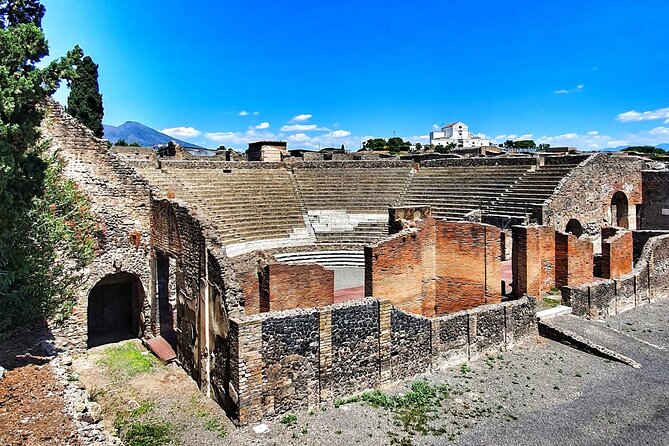
Stop 8: Teatro Grande (15 minutes, ticket included)
Finally, you reach Teatro Grande, or the Large Theatre. It was built around the middle of the 2nd century BC and restored in Roman style. The tour description states performances included comedies and tragedies from Greek Roman tradition.
One detail that helps the stop feel concrete: this theatre is described as the first large public building completely freed from deposits of the eruption. That explains why it’s such a standout for many visitors—it shows how excavation and preservation can reveal public life fast.
This is a good closing stop because theatre is the place where entertainment, civic culture, and crowd behavior all meet. After baths, markets, and the Forum, it rounds out the picture.
Price and value: is about $96 worth it?
At $96.38 per person for a roughly 4-hour visit, the value is mostly in what you get bundled:
- Transfers from Sorrento or Naples
- 30-seater bus ride
- English-speaking guide (about 2 hours)
- Headsets
- Pompeii entrance ticket included
If you’ve ever tried to plan Pompeii day-of on your own, you know the hidden costs: time spent figuring out timing, buying tickets, and working around entry processes. Here, you’re paying for structure and interpretation. I see that as good value if this is your first visit and you want a guided overview.
What can make it feel less worth it is the time limit. You’re not paying for a half-day to become a Pompeii scholar. You’re paying to get oriented and get a strong snapshot across multiple key zones.
Pace, crowds, and the one real risk to plan for
This tour is built to move. The itinerary assigns lots of short stops, and Pompeii will still throw the occasional crowd slowdown at you. Headsets help with guide clarity, but they can’t remove congestion.
The one real risk you should keep in your head is transportation change. One documented issue involved a bus mechanical problem that led to a private car/minivan transfer for a small group, which created confusion and extra waiting. That’s not something you can control, but being mentally ready for delays makes the day smoother.
My practical advice: keep your schedule loose the rest of the day. Don’t stack another time-sensitive activity right after. Pompeii is worth it, but travel days are unpredictable.
Who this tour is best for
This fits best if:
- it’s your first time at Pompeii and you want context fast
- you prefer a guided route instead of self-navigation
- you want included transfers from Sorrento or Naples
- you like the idea of seeing public life, baths, and entertainment in one visit
It may not fit if:
- you’re the type who wants to go slow and linger in details for a long time
- you plan to do extra Pompeii stops on your own without help
- you’re strongly sensitive to any chance of transport delays
Should you book this Pompeii skip-the-line guided tour?
If you want a smart first look at Pompeii without turning your day into logistics, I’d book it. The combination of included ticket, headsets, and a focused route makes this a practical win, especially if you’re short on time or traveling with kids who benefit from structure. One praised guide named Gino was specifically noted for being very informative, and that kind of human factor matters in Pompeii.
If you’re dreaming of a long, slow, wander-all-day Pompeii experience, this isn’t that. It’s a guided sprint through major highlights. Think of it as: get your bearings fast, learn the stories, then decide later if you want to return for deeper exploration.
FAQ
How long is the Pompeii guided tour?
The tour lasts about 4 hours.
What stops are included during the visit?
You’ll visit multiple key areas including the Archaeological Park of Pompeii, the Forum, the Temple of Jupiter, the Macellum, Via dell’Abbondanza, the Stabian Baths, the brothel, and Teatro Grande.
Is the Pompeii entrance ticket included?
Yes, the entrance ticket to Pompeii is included.
Do I need lunch during the tour?
Lunch is not included.
What language is the guide?
The tour offers an authorized English-speaking guide.
Will I get help hearing the guide in crowded areas?
Yes. Headsets are included to hear the guide clearly.
Where does pickup happen?
Pickup is available at the meeting point in Sorrento or Naples.
Can I cancel if plans change?
Free cancellation is allowed up to 24 hours in advance for a full refund.
What happens if the weather is poor?
This experience requires good weather. If it’s canceled due to poor weather, you’ll be offered a different date or a full refund.
More Tours in Sorrento




More Tour Reviews in Sorrento
- Sorrento Farm and Food Experience including Olive Oil, Limoncello, Wine tasting
★ 5.0 · 2,524 reviews



Back to Pompeii


Just off the boat: newer Sorrento reviews




Pompeii from Sorrento, compared.
 ★ 4.8Skip-the-Line Pompeii Express Tour by TrainFrom $632,038 reviews
 ★ 4.5Priority Access Pompeii & Mt. Vesuvius Full day from SorrentoFrom $1391,376 reviews
 ★ 4.5Pompeii Express Guided Tour by Train from SorrentoFrom $65770 reviews
 ★ 4.7Pompeii Half-Day Guided Tour with Priority AccessFrom $84739 reviews
 ★ 4.5Skip-the-Line Pompeii Guided Tour from SorrentoFrom $90722 reviews
 ★ 4.0Pompeii Ruins Half-Day Tour from Sorrento with GuideFrom $97714 reviews
 ★ 4.8Pompeii and Vesuvius Guided Tour with LunchFrom $130683 reviews
 ★ 4.3Day Tour to Pompeii Ruins and Mount VesuviusFrom $130489 reviews
Browse the lists this tour appears in