
Review · POMPEII FROM SORRENTO
Private Pompeii Tour with Archaeologist & Winery on Mt Vesuvius
Pompeii feels personal when you’re walking with an archaeologist. This private tour strings together the Forum-area highlights plus standout houses, baths, and theaters, then finishes with a winery lunch on the slopes of Mount Vesuvius. I especially like the custom pace—the guide tunes the day to your physical comfort—and the practical skip-the-line entry approach that helps you lose less time to ticket lines.
The second thing I like: you get Pompeii’s big ideas explained in plain, real-world terms (how people ate, shopped, bathed, judged disputes, and staged entertainment). One drawback to plan for: Pompeii and the winery are still a lot of walking, and the lunch and wine tasting are an added cost you pay on-site, since the tour price doesn’t include it.
In This Review
- Key Points at a Glance
- Why This Pompeii + Vesuvius Combo Works
- Pickup, Transfers, and the Skip-Line Advantage
- Entering Pompeii Through Porta Marina
- The Forum Core: The City’s Court, Commerce, and Beliefs
- Basilica Pompeiana (Courthouse and Business Center)
- Temple of Apollo (Oldest Forum Sacred Landmark)
- Forum of Pompeii (The Square Where Life Happened)
- Macellum (Covered Market and the Imperial Connection)
- Forum Baths and Pompeii’s Social Life
- Seeing How Wealth Looked: House of the Faun and Casa dei Vettii
- House of the Faun (Opulence and Big Architecture)
- Casa dei Vettii (The Fourth-Style Showstopper)
- Newer Angles: Insula dei Casti Amanti and Teatro Grande
- Insula dei Casti Amanti (Reopened Route Over Active Archaeology)
- Teatro Grande (Acoustics and the Social Ladder)
- Antiquarium di Pompei: A Fast Start That Makes the Ruins Make Sense
- Mt. Vesuvius Winery: Lunch With Five Wines (And Pay On Site)
- Timing, Pace, and What to Bring
- Is the Price Worth It?
- Who This Tour Suits Best
- Should You Book This Pompeii Tour With the Winery Stop?
- FAQ
- How long is the Pompeii and Vesuvius private tour?
- What does the tour price include?
- Is the winery lunch and wine tasting included in the price?
- Does this tour reach the top of Mount Vesuvius?
- Is the tour private or shared?
- What language is the tour offered in?
- Is pickup available?
Key Points at a Glance
- Private Pompeii time with an archaeologist guide who adjusts to your pace and interests
- Skip-the-line Pompeii Express admission included, with a mobile ticket option
- Forum-focused highlights: Basilica, Temple of Apollo, Macellum, Forum Baths, and more
- Elite-home stops like Casa dei Vettii and House of the Faun, with major art described in context
- Vesuvius winery finish in Mt. Vesuvius National Park with lunch and five wines
- No summit visit: the experience doesn’t reach the top of Mount Vesuvius
Other ways to walk into Pompeii
- Sorrento: Skip-the-Line Pompeii Express Tour by Train★ 4.8 · 2,038 reviews
- Priority Access Pompeii & Mt. Vesuvius Full day from Sorrento★ 4.5 · 1,376 reviews
- Pompeii Express Guided Tour by Train from Sorrento★ 4.5 · 770 reviews
- Sorrento: Pompeii Half-Day Guided Tour with Priority Access★ 4.7 · 739 reviews
Why This Pompeii + Vesuvius Combo Works
Pompeii is one of those places where your day can go sideways fast. Show up with no structure and you’ll spend most of the visit staring at buildings that don’t yet mean much. This tour gives you a route that builds understanding step by step, so the ruins start to feel like a functioning city again.
I also like that you’re not just doing “ruins for ruins’ sake.” Pompeii is about daily life: courtrooms, markets, bathrooms, theaters, and homes for people with very different incomes. The guide’s style is hands-on and practical, and it matters here because the park is huge. Even though the walking is focused on the Forum area and key highlights, you’ll still cover enough ground that moderate fitness really helps.
Then you get a palate reset with a vineyard lunch in Mt. Vesuvius National Park. You’re not driving back through your afternoon guessing what’s next. It’s a clean arc: Pompeii’s city life, then a relaxed meal with local wines tied to the same volcanic region.
Pickup, Transfers, and the Skip-Line Advantage
This is set up as a stress-light private day. You’ll have pickup available, and you travel in an A/C Mercedes van from either Naples or Sorrento. That matters more than people think. Getting to Pompeii on your own can involve juggling transport and timing. Here, the transport plan is part of the value.
On the entry side, Pompeii Express skip-the-line tickets are included, plus you get a mobile ticket. The practical benefit: you should spend more time walking the Forum highlights and less time stuck at the start gate. One review highlighted how professional and punctual the guide was, and that first timing piece often makes the whole day feel smoother.
Consideration: you still need to be ready for a moderate walking day. The park can be uneven and spread out, even when the itinerary is arranged around the major hits.
Entering Pompeii Through Porta Marina
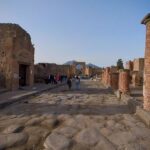
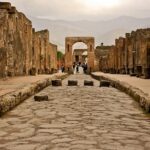
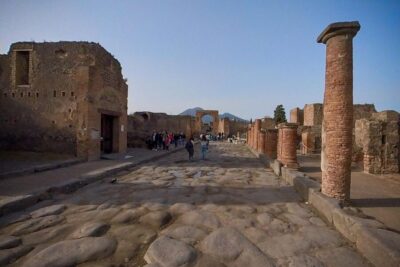
The tour starts with a dramatic entrance: Piazza Porta Marina and its dual-arched gate. You don’t just walk into the park—you’re shown the idea of Pompeii as a city built for movement and control. The gate connects into the city’s defensive walls and acts like a “main door” onto the urban core.
As you move up the slope along Via Marina, the guide brings your attention to how the layout funnels you toward the administrative and religious center—so the Forum doesn’t feel random. You’ll also pass by the area connected with the Antiquarium museum and the Suburban Baths, which gives you a sense of where you’ll be focusing next.
This is a good start point because you’re getting oriented early. Pompeii’s ruins can feel like scattered rooms. Early orientation helps you recognize patterns as you go.
The Forum Core: The City’s Court, Commerce, and Beliefs
Most of the real “wow” of this tour is how it strings together the Forum-area structures in a logical sequence. You go from major public authority to sacred power to commerce and then into daily social life.
More trips up to the crater

Basilica Pompeiana (Courthouse and Business Center)
Next you’ll visit the Basilica Pompeiana at the southwest corner of the Forum. What I like here is that the guide explains the building’s job without making it sound like a lecture.
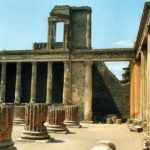
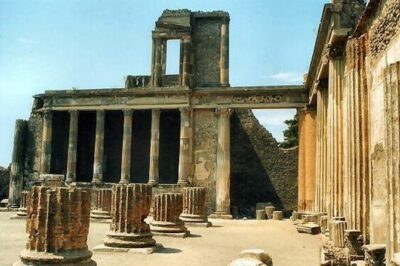
This basilica was the big secular power center: courthouse and commerce hub, with a grand three-aisled layout. You can still walk the length of the main nave, and you’ll see the bases of 28 columns that once rose up to roughly 11 meters. At the far end, there’s the raised platform where magistrates presided—so you can picture how decisions happened in public.
The payoff: it reframes Pompeii from a tragic site into a functioning legal and economic machine.
Temple of Apollo (Oldest Forum Sacred Landmark)
Then comes the Temple of Apollo, one of Pompeii’s older sacred sites, with origins that reach back to the 6th century BC and a Greek-Italic architectural blend. The surrounding portico has 48 columns, and the elevated podium helps you understand how the temple dominated the Forum’s western side.
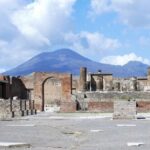
A fun detail you’ll hear about: replicas of bronze Apollo and Diana (the originals are housed in Naples) stand guard over the courtyard. You can also spot the white marble altar and an Ionic column with a sundial. There’s a strong visual payoff too, including a view that points toward Mount Vesuvius—a nice way to hold the entire day’s theme in your mind.
Forum of Pompeii (The Square Where Life Happened)
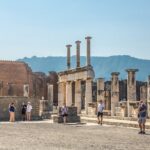
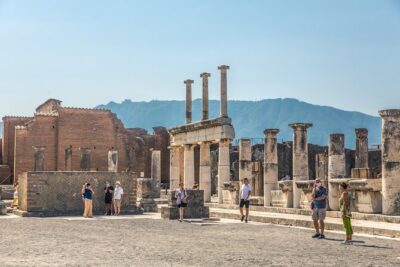
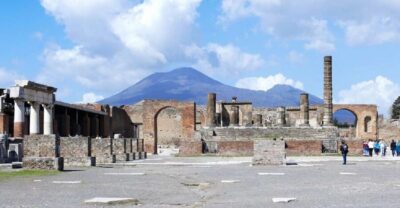
The tour then steps into the Forum itself: a rectangular, car-free plaza that was the political, commercial, and religious heartbeat. It’s the hub for daily markets, ceremonies, and legal proceedings. You’ll walk the travertine paving stones and see remaining column pedestals that once held statues of emperors and notable citizens.
I like that the guide keeps connecting the buildings around the square to what people did there each day. If you’ve ever walked around a ruin and wondered what it was used for, this is where the tour fixes that.
Macellum (Covered Market and the Imperial Connection)
From the main square, the tour moves to the Macellum, Pompeii’s primary covered food market. This stop gives you a human-scale view of the economy—what people bought and how trade worked.
You’ll see the market’s central courtyard with a circular pavilion (a tholos), and the drainage system preserved evidence linked to seafood handling. Around it are the small shops (tabernae) selling meats, fruits, and vegetables, plus a shrine on the eastern side honoring the imperial family. That shrine is the key point: even commerce was tied to state religion.
You can also observe frescoes with mythological scenes and market goods, plus the mensae ponderariae (the stone table used to verify weights and measures). The detail is practical. It makes fairness in trade feel real.
Forum Baths and Pompeii’s Social Life
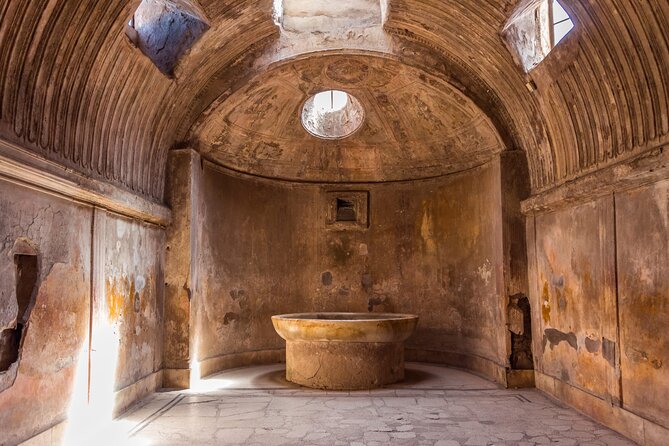
If you want a strong sense of what a “day out” looked like, the Forum Baths (Terme del Foro) deliver. This complex is special because it was still fully operational at the time of the 79 AD eruption.
You’ll move through the sequence of rooms:
- apodyterium (changing room)
- frigidarium (cold bath)
- tepidarium (warm room)
- calidarium (hot room)
I like the way you can actually see the engineering logic. There are stucco reliefs on vaulted ceilings, a bronze brazier used for heat, and visible systems connected to hypocaust—the hot air circulation underneath floors. Recent restoration has also opened the women’s section, showing frescoes and giving you a clearer idea of who socialized and how.
A small caution: baths are fascinating, but they can be tiring because you’re often moving through multiple rooms. If your feet tire easily, tell the guide early so the pace can slow down.
Seeing How Wealth Looked: House of the Faun and Casa dei Vettii
Pompeii’s elite homes can feel like another world—because they were. This tour hits two major stops that show you scale, art, and how wealth shaped daily life.
House of the Faun (Opulence and Big Architecture)
The House of the Faun (Casa del Fauno) is one of Pompeii’s largest and most luxurious residences. You’ll walk through a sprawling layout that occupies an entire city block (an insula), with two peristyle gardens and two atriums.
Two iconic features you’ll hear about are now mainly known through replicas. The house is named for the bronze “Dancing Faun” statue (original art is in Naples), and it’s also tied to the dramatic Alexander Mosaic (also in Naples). Even if you’re not seeing the originals here, walking through the scale helps you understand why these artworks mattered.
Casa dei Vettii (The Fourth-Style Showstopper)
Next is the Casa dei Vettii, often described as a high-impact art experience inside Pompeii. This home belongs to two brothers who rose from slavery to become wealthy merchants, and the house is famous for vivid Fourth Style frescoes.
You’ll hear about the entry painting of Priapus—a symbol tied to prosperity—and then you move into rooms where you can see mythological scenes and very detailed “miniature world” work, including the Room of the Cupids and imagery tied to trades. A peristyle garden brings it all together, and the tour notes that the garden is replanted to reflect ancient patterns, with fountain statues used to recreate the feeling of a complete household.
This is a top pick if you like homes as social history, not just stone shells.
Newer Angles: Insula dei Casti Amanti and Teatro Grande
Not all Pompeii visits give you a sense of how archaeology still works. This tour does, with a stop tied to ongoing research and public viewing.
Insula dei Casti Amanti (Reopened Route Over Active Archaeology)
The Insula dei Casti Amanti area (Block of the Chaste Lovers) is described as a modern access win. It reopened to the public in 2024 with an elevated walkway system that lets you view architecture from above and see excavation beneath.
If you like the idea of history being uncovered in real time, this is a meaningful break from “finished ruins.” It also connects to the broader Pompeii for All barrier-free itinerary concept, meaning the route is designed to help more visitors access the site.
Teatro Grande (Acoustics and the Social Ladder)
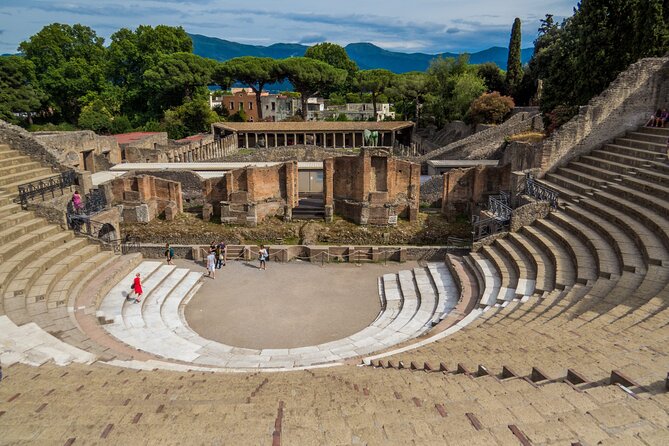
Then you head to Teatro Grande, Pompeii’s large theater. It’s horseshoe-shaped and carved into a natural hillside, with seating estimated around 5,000.
The big interpretive point is social hierarchy. You’ll see how seating sections map onto social rank, from the ima cavea for local elites to higher sections for the general populace. There’s also an acoustics legacy you can test by speaking from the orchestra center—an old trick, but it works.
In 2026, the theater is still used for cultural events, including major seasonal programming and special performances. Even if you’re not there for a show, it helps you understand that the site isn’t only a museum object—it’s part of modern local life.
Antiquarium di Pompei: A Fast Start That Makes the Ruins Make Sense
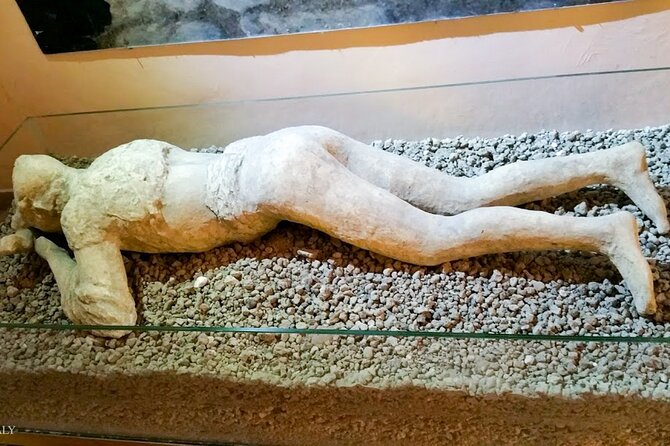
Before you head into the deeper ruins feeling, this tour includes time at the Antiquarium di Pompei, housed at the Porta Marina entrance.
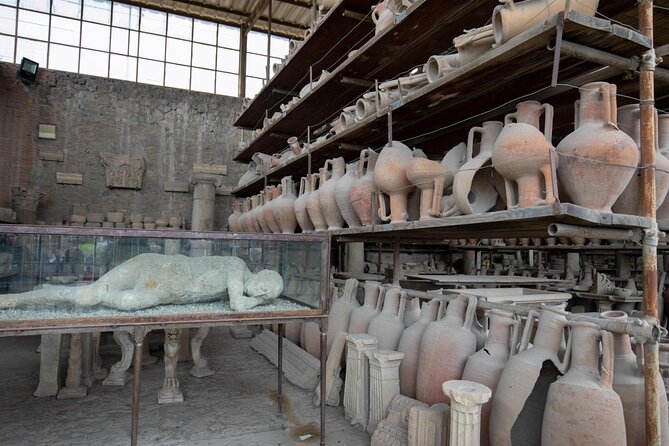
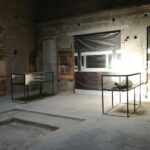
What I like is that it’s climate-controlled and organized to explain Pompeii in a way the ruins alone can’t do. The museum traces the city from Samnite roots into its tragic end in 79 AD and highlights key artifacts and fresco subjects. You’ll also see world-famous plaster casts connected to victims and key moments, which add a human layer when you’re about to be surrounded by preserved rooms.
The museum experience also includes multimedia projections and digital assistants in 2026, which can help you connect details faster when you’re moving from “what is this building?” to “how did people live here?”
Mt. Vesuvius Winery: Lunch With Five Wines (And Pay On Site)
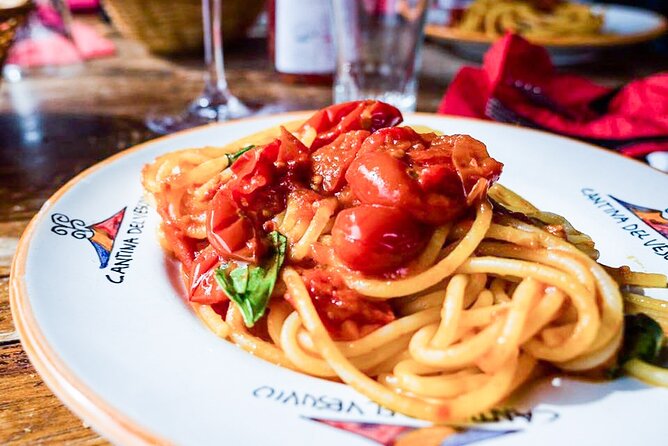
This is the payoff section: the day shifts from stone and dust to vineyards and food. The winery stop is at Cantina del Vesuvio by the Russo family since 1930, set inside Mt. Vesuvius National Park.
You get a guided 15-minute stroll through vineyards and learn about the famous Lacryma Christi wine. Then lunch arrives as a set menu paired with five local wines.
The menu described is classic Neapolitan comfort food:
- appetizers including bruschetta, cheeses, and cured meats
- spaghetti with Vesuvius cherry tomatoes (plus meatballs)
- Pastiera for dessert, with vegetarian/GF options available
Cost note: this winery lunch and tasting is not included in the tour price. You pay on-site when you arrive (handled by the guide). The Classic tasting is €55 per person, and the Superior wine experience is €65.
Two practical pros: this is a sit-down meal, so you’re recharging your legs. And you’re tasting wines from the volcanic region you’ve been thinking about all day.
One more reality check: this experience does not reach the top of Mount Vesuvius. You’ll enjoy the mountain context from the winery area, but it’s a different kind of Vesuvius day than a full summit excursion.
Timing, Pace, and What to Bring
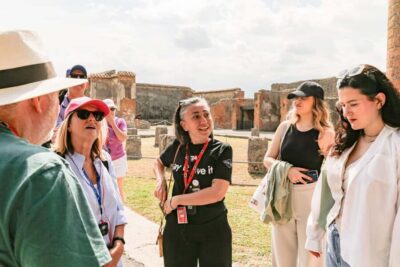
The tour runs about 4 to 7 hours depending on what you choose and how you move through the site. Since it’s a private tour, your guide can flex the day, which is a major part of the value. In multiple comments about the guide, you’ll see a pattern: he checks what you want to see and adjusts accordingly, even for travelers who need a slower pace.
For what to bring, think in terms of comfort:
- solid walking shoes (Pompeii surfaces can be tough)
- water (you can also rely on the guide having drinks in the van—at least some days include this)
- sun protection and a light layer (the winery and park can swing in temperature)
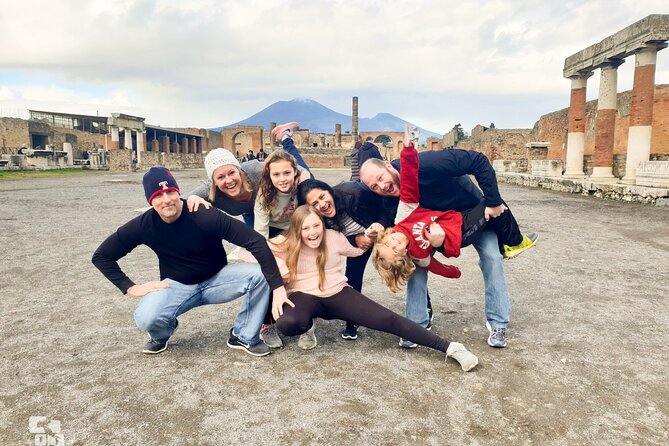
If you want photos, plan a few extra minutes. The most iconic views—especially the Vesuvius direction from the Forum—are the kind you’ll want to linger on.
Is the Price Worth It?
At $434.46 per person, you’re paying for three big things:
- Private guide time with an archaeologist
- Private A/C Mercedes transfers from Naples or Sorrento
- Skip-the-line Pompeii admission handled for you
That doesn’t mean it’s cheap. It means you’re buying a smoother day than if you self-plan, especially once you factor in private timing and guided navigation of Pompeii’s most meaningful buildings.
Then there’s the optional add-on cost: the winery lunch and tasting. If you choose to do the Classic or Superior menu, add €55–€65 per person on top for the full experience. I think that’s still good value because it bundles a vineyard orientation plus a real sit-down lunch with five wines, not just a quick pour.
Where the value is strongest: if you care about explanations and don’t want to waste your limited vacation hours sorting logistics.
Who This Tour Suits Best
This is a great match if you want:
- a structured Pompeii route with clear meaning behind what you’re seeing
- private attention and the ability to slow down
- a comfortable finish with food and wine instead of heading back straight to hotels
It may be less ideal if you’re trying to do Pompeii in a totally minimalist way. This day is not just “wander and hope.” It’s built around guided stops and walking between them.
If you’re traveling with children, the tour notes that children must be with an adult. Also, service animals are allowed. Overall, this fits travelers with moderate physical fitness.
Should You Book This Pompeii Tour With the Winery Stop?
I’d book it if you want Pompeii to feel organized and human, not overwhelming. The private format plus the skip-line entry is a strong combo. Add the fact that the guide is known for being punctual, friendly, and able to tailor the route, and you get the kind of day that usually turns into a highlight story.
Skip it if you’re on a tight budget and want everything included, since the winery lunch and tasting are extra. Also skip it if your top goal is reaching the actual summit of Mount Vesuvius—this day does not go to the top.
If you’re coming to the Sorrento/Naples area and want one memorable, well-run Pompeii day followed by real local hospitality, this is the kind of plan that makes your time count.
FAQ
How long is the Pompeii and Vesuvius private tour?
It runs about 4 to 7 hours (approx.), depending on pacing and how the day flows.
What does the tour price include?
The package includes Pompeii Express skip-the-line admission, A/C Mercedes van transfers, a private walking tour with an official guide, and private pickup and drop-off. The winery lunch and wine tasting are not included.
Is the winery lunch and wine tasting included in the price?
No. You pay on-site for the winery experience. It’s listed as €55 per person for Classic or €65 per person for Superior.
Does this tour reach the top of Mount Vesuvius?
No. The winery visit is in the area of Mt. Vesuvius National Park, but the tour does not reach the summit.
Is the tour private or shared?
This is a private tour/activity. Only your group participates.
What language is the tour offered in?
The tour is offered in English.
Is pickup available?
Yes. Pickup is offered, and you’ll be asked to share where to meet and a phone number for the day.
More Tour Reviews in Sorrento
- Sorrento Farm and Food Experience including Olive Oil, Limoncello, Wine tasting
★ 5.0 · 2,524 reviews





More Days on Vesuvius

Back to Pompeii
Just off the boat: newer Sorrento reviews



Pompeii from Sorrento, compared.
 ★ 4.8Skip-the-Line Pompeii Express Tour by TrainFrom $632,038 reviews
 ★ 4.5Priority Access Pompeii & Mt. Vesuvius Full day from SorrentoFrom $1391,376 reviews
 ★ 4.5Pompeii Express Guided Tour by Train from SorrentoFrom $65770 reviews
 ★ 4.7Pompeii Half-Day Guided Tour with Priority AccessFrom $84739 reviews
 ★ 4.5Skip-the-Line Pompeii Guided Tour from SorrentoFrom $90722 reviews
 ★ 4.0Pompeii Ruins Half-Day Tour from Sorrento with GuideFrom $97714 reviews
 ★ 4.8Pompeii and Vesuvius Guided Tour with LunchFrom $130683 reviews
 ★ 4.3Day Tour to Pompeii Ruins and Mount VesuviusFrom $130489 reviews
Browse the lists this tour appears in