
Review · POMPEII FROM SORRENTO
From Naples: Pompeii Skip-the-Line Guided Tour
Pompeii feels too real to ignore. This Naples tour is built for speed and comfort: early departure plus skip-the-line priority access means you start walking while the site is still manageable. You’ll follow a licensed local guide through Pompeii’s key streets and buildings, with narration that helps the ruins make sense, fast.
I like the structure: you get a tight 2½-hour guided walk that hits the places you’ll actually remember. I also love the emotional stops, from the plaster casts to the Alexander Mosaic in the House of the Faun. One big consideration: this is still a walking tour in an outdoor archaeological park, with sun and uneven ground, and it’s not suitable for people with mobility impairments or heart problems.
In This Review
- Key things to know before you go
- From Naples to Pompeii: how the day is set up
- Skip-the-line entry and audio headsets that actually help
- Walking the power center: Porta Marina to the Civil Forum
- Via dell’Abbondanza and the Theater District’s social rhythm
- Terme Stabiane and everyday rituals you can spot fast
- Lupanare, street food, and the parts of daily life people remember
- The House of the Faun and the Alexander Mosaic moment
- Macellum and the plaster casts: Pompeii’s human ending
- Price and what you’re really buying for $71
- Who this Pompeii tour suits best
- Should you book this Pompeii Skip-the-Line guided tour from Naples?
- FAQ
- How long is the Pompeii guided tour from Naples?
- Where do I meet the guide in Naples?
- Is this tour really skip-the-line?
- How long is the guided walk inside Pompeii?
- What languages are available for the tour?
- Do we get audio headsets?
- Is lunch or food included?
- What should I bring?
- Is the tour suitable for mobility impairments?
- Can the group be split into smaller parties?
- Is free cancellation available?
Key things to know before you go
- Early start from Naples helps you beat the heaviest crowd pressure.
- Priority access via a separate entrance gets you into Pompeii faster.
- 2½-hour guided route focuses on the main highlights in a logical order.
- Audio headsets for groups 8+ keep you hearing the guide, even in busy areas.
- There’s plenty of variety: politics, homes, baths, street food, and theater.
- Bring sun protection; the site isn’t set up like a shady museum.
Other ways to walk into Pompeii
- Sorrento: Skip-the-Line Pompeii Express Tour by Train★ 4.8 · 2,038 reviews
- Priority Access Pompeii & Mt. Vesuvius Full day from Sorrento★ 4.5 · 1,376 reviews
- Pompeii Express Guided Tour by Train from Sorrento★ 4.5 · 770 reviews
- Sorrento: Pompeii Half-Day Guided Tour with Priority Access★ 4.7 · 739 reviews
From Naples to Pompeii: how the day is set up
Your day starts in Naples at Starhotel Terminus, outside the main entrance on Piazza Giuseppe Garibaldi 91. Plan to arrive a bit early. A couple of people note that meeting can feel chaotic until the correct coordinator and guide lineup is sorted out.
Then you’re on an air-conditioned bus for about 30 minutes to reach the site area. The comfort matters here because Pompeii is where the walking and heat show up. Once you arrive, priority access helps you avoid the worst of the lines and get straight into the ruins with momentum.
A smart detail: because Pompeii regulations can require it, your group may be split into smaller parties with their own licensed guide. That’s not ideal for mingling, but it usually makes the experience feel smoother and easier to follow.
Skip-the-line entry and audio headsets that actually help
This tour’s headline is priority access through a separate entrance. In real life, that changes everything: you’re not spending your most energetic hours stuck waiting, and you’re not as rushed when you finally get inside.
Inside Pompeii, your guide’s story is the main event. If you’re in a group of 8 or more, you’ll get audio headsets. They help a lot at the Theater District and around the big popular points, where sound carries poorly. One caution from experience: when crowds push you farther from the guide, headset audio can get patchy. If you want clean narration, keep within the guide’s cluster when you can.
Walking the power center: Porta Marina to the Civil Forum
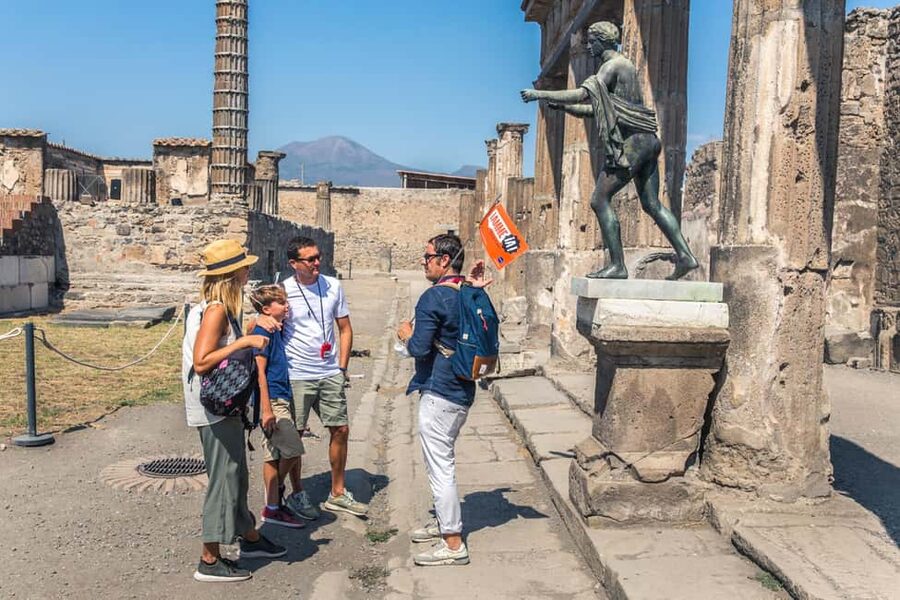
The tour route begins at Porta Marina, one of Pompeii’s original gates. That’s a great starting point because it instantly gives you orientation. Instead of wandering, you’re moving into the city like you’re stepping through the entrance of a living place.
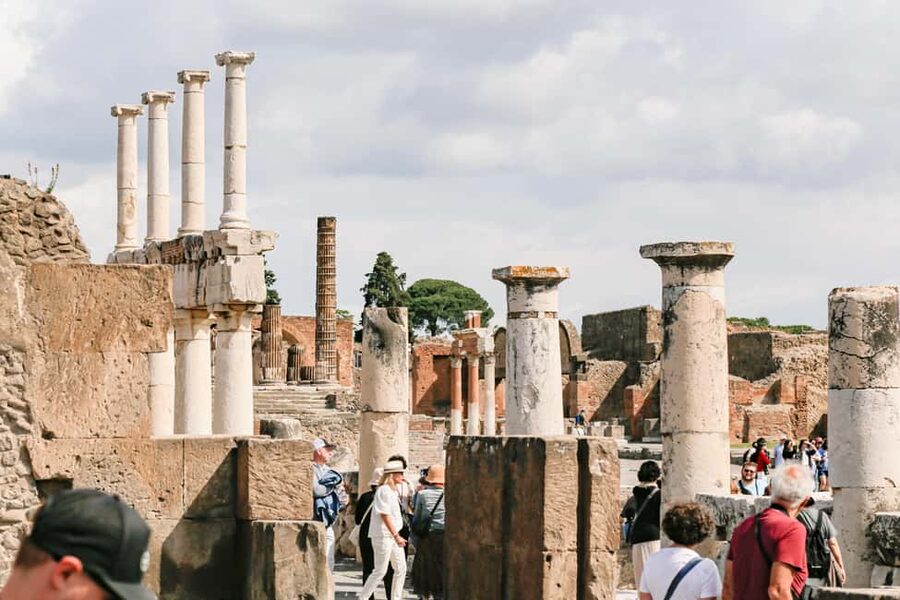
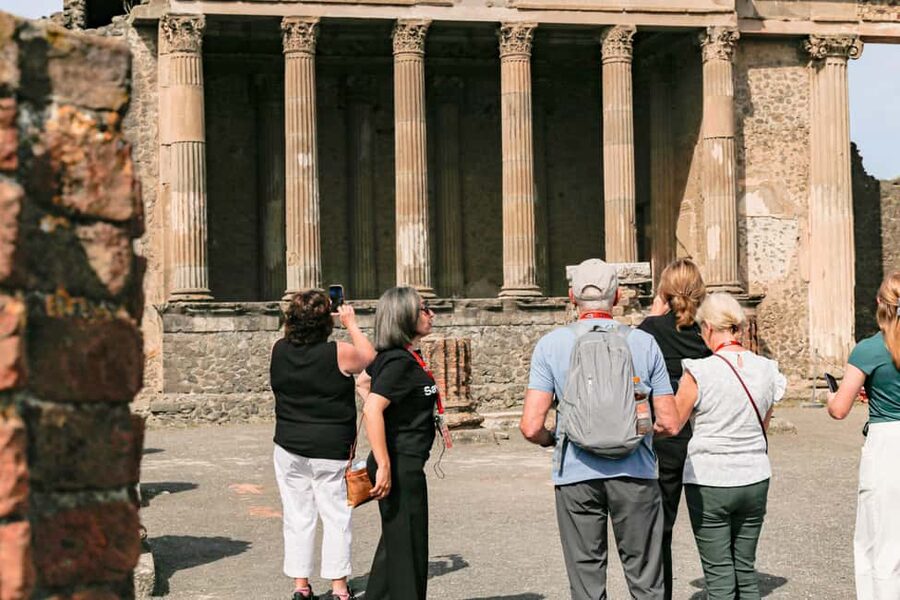
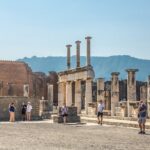
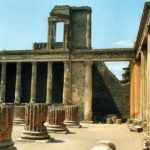
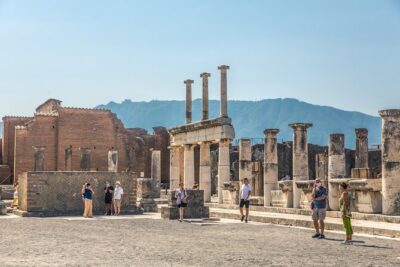
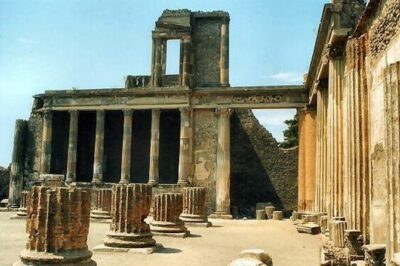
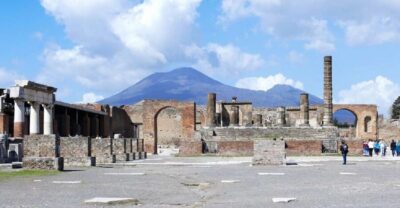
Next comes the Civil Forum, Pompeii’s political, religious, and commercial heart. This is where you start seeing how public life worked: temples and major public buildings set the tone, and the Basilica tells a business-and-legal story. Even if you’ve visited a Roman ruin before, Pompeii’s street scale and layout help you picture how people moved through decisions, commerce, and ceremonies.
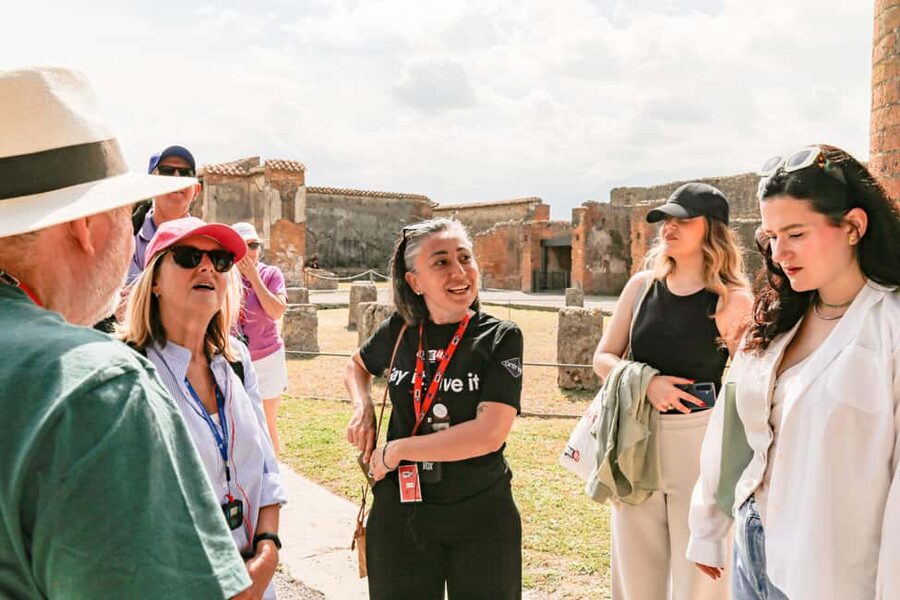
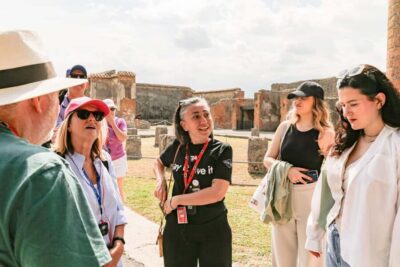
The guide’s job here is translation: they connect stone locations to everyday behavior. Some guides (like Luigi and Lucia in past groups) use a teaching style that can feel like a professor with humor—great when you want the details, less great if you prefer silence and self-guided reading.
Photo stops are folded into the route too, so you’re not purely running from spot to spot. You’ll get brief chances to reset your phone camera without losing the thread of the tour.
Via dell’Abbondanza and the Theater District’s social rhythm

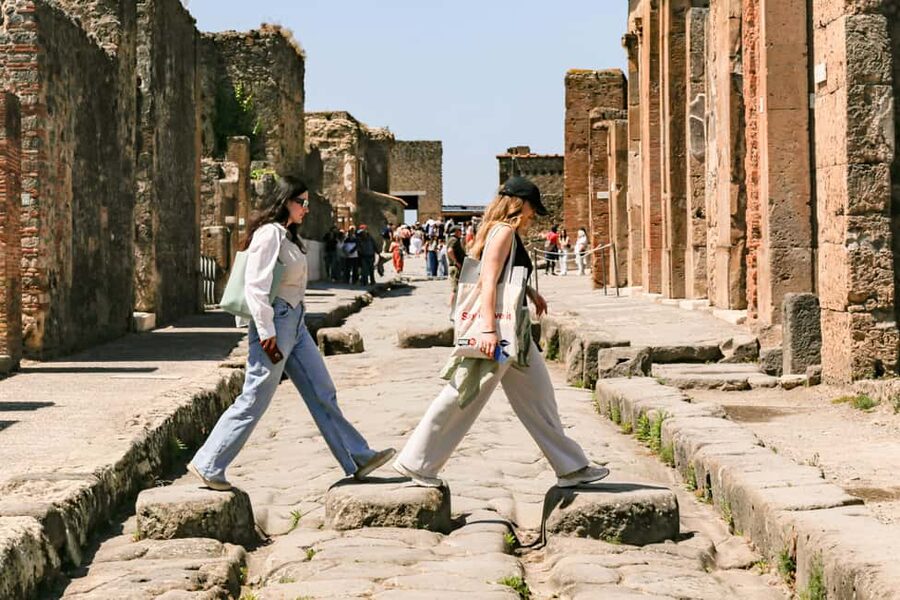
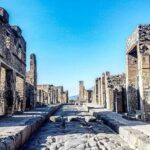
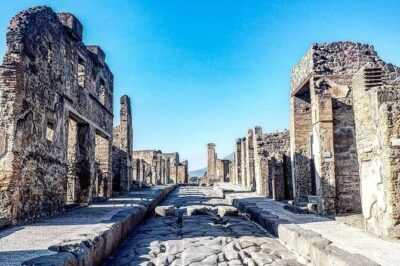
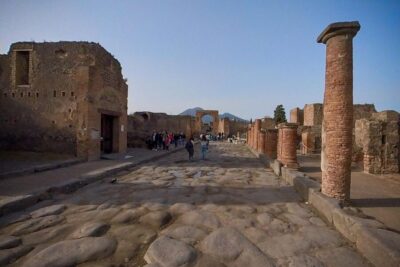
One of the route’s strongest sections is the walk down Via dell’Abbondanza, Pompeii’s main street. This part isn’t just scenic. You’re reading the city in the pavement itself—there are deep chariot grooves etched into the stone, a small but powerful clue to how much traffic passed through daily.
From there you reach the Theater District, where public entertainment and social life overlapped. The Large Theater is the star. It’s open-air, so you feel the scale the way ancient audiences would have. The guide explains how comedies, dramas, and musical performances fit into the city’s calendar and community life.
A practical point: theaters and forum areas are also where crowds gather hardest. The tour helps you stay focused on what to look for first. If you arrive early enough, you’ll still feel the space rather than getting swallowed by the mass.
More reasons to jump the train to Naples




Terme Stabiane and everyday rituals you can spot fast
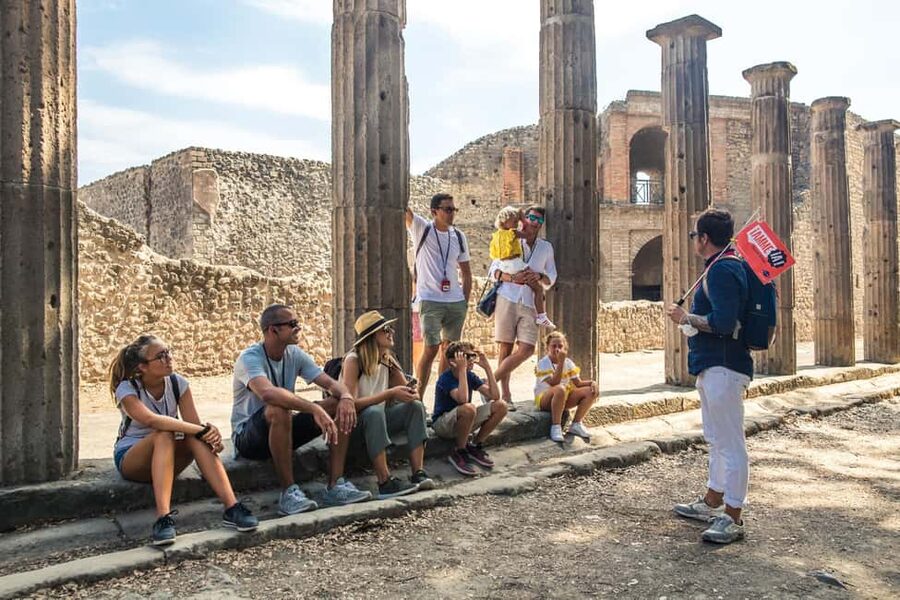
A preserved bath complex, Terme Stabiane, gives you a different side of Pompeii: relaxation, routine, and socializing. Roman baths weren’t just about hygiene. They were public space—places to talk, recover, and unwind.
This stop tends to be popular because the layout is easier to understand than some of the more fragmented house interiors. Even if you’re not an architecture person, you’ll likely find that the bath areas make the day feel more human and less like a catalog of ruins.
Drawback here: baths and shaded areas are limited. If your visit hits a hot day, the walking between stops can feel like the hardest part of the entire trip. Stick close to the guide early in the route, then use any small breaks to hydrate and catch your breath.
Lupanare, street food, and the parts of daily life people remember
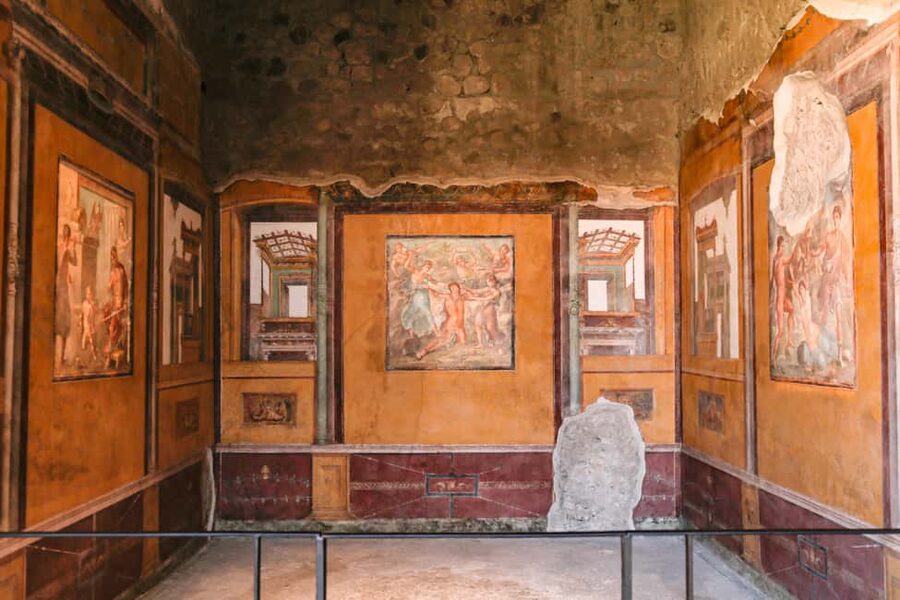
The Lupanare (Pompeii’s ancient brothel) is one of the tour’s most talked-about stops. The vivid frescoes and compact stone rooms make it feel less like a distant scandal and more like a business with customers and regular patterns. The guide’s narration helps keep this grounded in context rather than sensation.
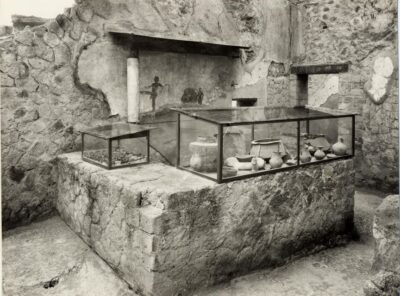
Right after that, you’ll pass through stops tied to day-to-day eating. Your route includes a Thermopolium (ancient street food shop) and a Pistrinum (bakery). These are the places that connect Pompeii to something you recognize instantly: milling grain, baking, and serving hot meals quickly for people on the move.
Look for the physical “working” parts. The tour highlights millstones, ovens, and counters—simple objects that suddenly feel important because they show how food production shaped neighborhoods.
If you’re the type who thinks ruins are just walls and columns, these stops can flip the script. You start realizing that Pompeii’s most shocking feature isn’t only death—it’s routine.
The House of the Faun and the Alexander Mosaic moment
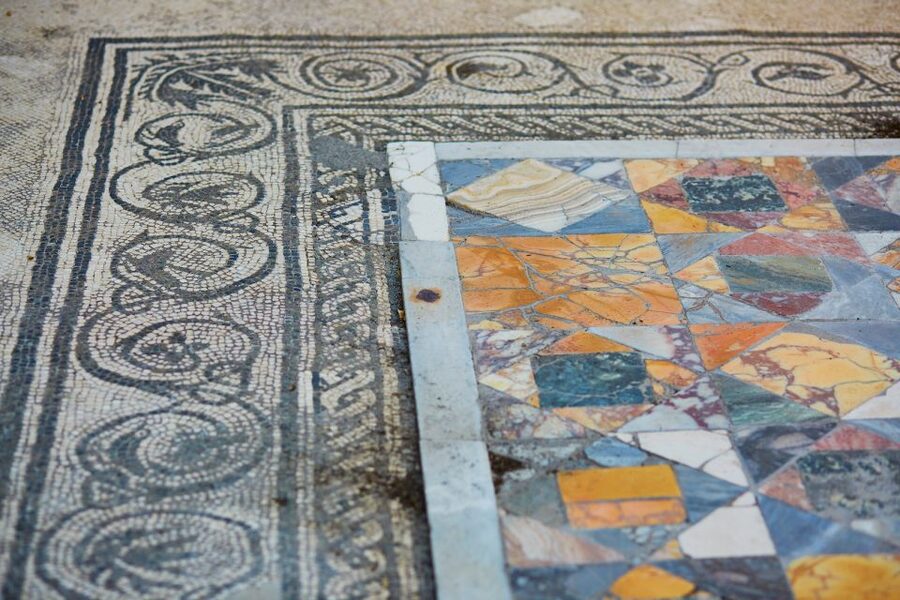
One of the best rewards of this tour is the House of the Faun, Pompeii’s grand Roman villa famous for its mosaics. This is where the city’s wealth becomes visible without needing a lot of imagination.
The highlight is the Alexander Mosaic, a standout artwork that’s famous for storytelling through detail. Even if mosaics aren’t usually your thing, this is the kind of image that makes you stop walking for a second and just look.
The guide typically explains what you’re seeing and why the design mattered in elite life. Some groups report that guides bring the villa to life with crisp, story-driven explanations. Others describe a slightly grumpy professor vibe from certain guides—still entertaining, but it’s a style choice.
This stop also works well as a calm break from the busiest public areas. You’ll still feel the heat, but the scene itself encourages slower attention.
Macellum and the plaster casts: Pompeii’s human ending
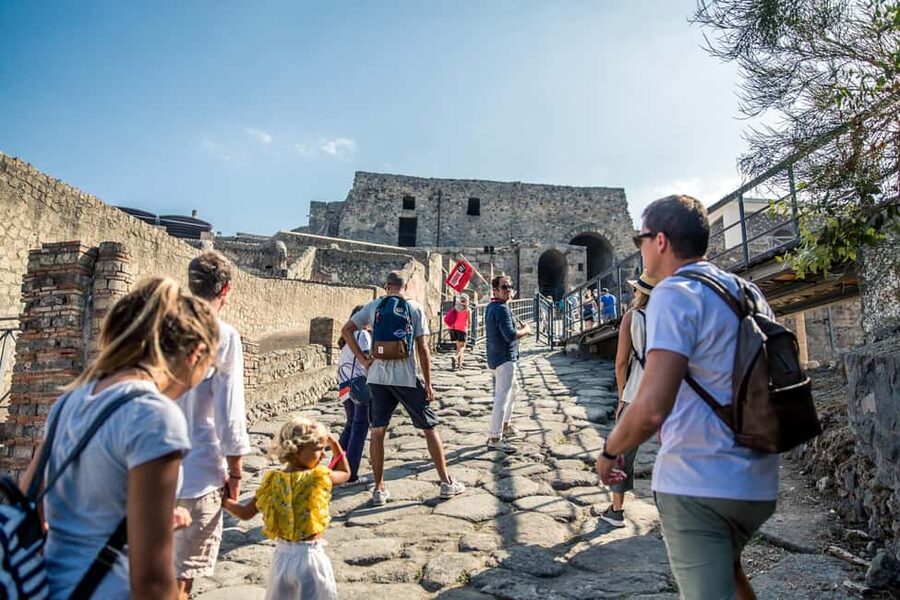
The tour finishes the Pompeii highlights near the Macellum, Pompeii’s food market. The market is your bridge back to everyday life: trade, supplies, and the sounds and scenes of busy neighbors gathering to eat and buy what they needed.
Then comes the most moving part of the Pompeii experience: the plaster casts of Pompeii’s victims. Men, women, and children are preserved in their final moments. The tour treats these as more than shocking artifacts. You’re encouraged to think about interrupted lives, not just a disaster as a headline.
If you’re sensitive, this can hit hard. That’s normal. This isn’t about being graphic—it’s about remembering that the ruins are the stage where people lived.
Price and what you’re really buying for $71
At around $71 per person for a roughly 4-hour experience, you’re paying for three big things: priority entry, live guide time (including the 2½-hour Pompeii walking component), and round-trip transport in an air-conditioned bus.
That’s good value if you want Pompeii structured for you. Pompeii is huge, and self-guided visits can turn into “spot-the-famous-stuff” only—especially if you’re trying to get your bearings quickly. Here, the route is designed to cover major areas in a way that creates a clear arc: entrance, civic power, entertainment, daily life, wealth, and the tragic aftermath.
One note: food and beverages are not included. Some guides may point you toward places to eat, and you might see optional meal stops depending on how the day is paced. Plan on bringing water and handling lunch on your own schedule.
Who this Pompeii tour suits best
This is a strong fit if:
- you want a high-impact Pompeii first visit without planning every turn
- you like guided storytelling that connects ruins to daily routines
- you’re traveling with limited time and want to be back for lunch in Naples
It may be a poor fit if:
- you need step-free routes or have mobility limitations (this tour is not suitable for mobility impairments)
- you have heart problems or would struggle with outdoor heat and walking
- you hate group pacing and prefer long, slow museum-style wandering
Should you book this Pompeii Skip-the-Line guided tour from Naples?
Book it if you want Pompeii to feel clear and organized, not overwhelming. The combo of early departure, priority access, and a live guide is what makes this trip work well in a short time window.
Skip it (or rethink it) if walking in the sun is a dealbreaker for you. Also, if you rely on audio and you tend to fall behind in crowds, you’ll want to stay near the guide as much as possible so you don’t miss key narration.
For many people, this is the most efficient way to get the “best of Pompeii” in one morning without turning the day into logistics.
FAQ
How long is the Pompeii guided tour from Naples?
The total duration is about 4 hours, including round-trip transport and the guided time in Pompeii.
Where do I meet the guide in Naples?
Meet your guide outside the main entrance of Starhotel Terminus at Piazza Giuseppe Garibaldi 91.
Is this tour really skip-the-line?
Yes. It includes priority access to Pompeii and uses a separate entrance to skip the main line.
How long is the guided walk inside Pompeii?
You get about 2½ hours of guided walking at the Pompeii Archaeological Site.
What languages are available for the tour?
The tour can run in English, French, Spanish, and German. If the minimum number of French or Spanish-speaking participants isn’t met, it will run in English, with French or Spanish commentary provided only during the guided visit of the Pompeii site.
Do we get audio headsets?
Audio headsets are provided for groups of 8+.
Is lunch or food included?
No. Food and beverages are not included.
What should I bring?
Bring comfortable shoes, sunglasses, and a sun hat.
Is the tour suitable for mobility impairments?
No. It is not suitable for people with mobility impairments.
Can the group be split into smaller parties?
Yes. Due to site regulations, groups may be divided into smaller parties, each with its own licensed guide.
Is free cancellation available?
Yes. You can cancel up to 24 hours in advance for a full refund.
More Tour Reviews in Sorrento
- Sorrento Farm and Food Experience including Olive Oil, Limoncello, Wine tasting
★ 5.0 · 2,524 reviews





More of Naples, One Stop Away

Back to Pompeii

Just off the boat: newer Sorrento reviews




Pompeii from Sorrento, compared.
 ★ 4.8Skip-the-Line Pompeii Express Tour by TrainFrom $632,038 reviews
 ★ 4.5Priority Access Pompeii & Mt. Vesuvius Full day from SorrentoFrom $1391,376 reviews
 ★ 4.5Pompeii Express Guided Tour by Train from SorrentoFrom $65770 reviews
 ★ 4.7Pompeii Half-Day Guided Tour with Priority AccessFrom $84739 reviews
 ★ 4.5Skip-the-Line Pompeii Guided Tour from SorrentoFrom $90722 reviews
 ★ 4.0Pompeii Ruins Half-Day Tour from Sorrento with GuideFrom $97714 reviews
 ★ 4.8Pompeii and Vesuvius Guided Tour with LunchFrom $130683 reviews
 ★ 4.3Day Tour to Pompeii Ruins and Mount VesuviusFrom $130489 reviews
Browse the lists this tour appears in